
Netherlands
The Netherlands ( Dutch : Nederland ) is a charming small country in the low-lying river delta of northwestern Europe . Its landscape of famously flat lands, much of it reclaimed from the sea,…
At a glance
Useful facts for planning
In this guide
Why go
Overview
The Netherlands ( Dutch : Nederland ) is a charming small country in the low-lying river delta of northwestern Europe . Its landscape of famously flat lands, much of it reclaimed from the sea, is dotted with windmills, blooming tulip fields and picturesque villages. The modern architecture and urban environments of quite a few cities are also becoming internationally prominent. With over 17 million people living in a relatively small area, this is a densely populated modern European country. Still, even the largest of its cities have retained elements of a laid-back, small-town atmosphere, and most are packed with historic heritage, for which there is much local pride.
The country is commonly referred to as Holland , but this name refers only to two of its twelve provinces and is unpopular among Dutch people who aren't from North or South Holland.
After the Eighty Years' War (1568-1648) that led to the country's de facto independence from Spain in 1581, the Netherlands became a great naval power and one of the world's most powerful nations in a period known as the Dutch Golden Age. Because of its naval and trading history, this small nation boasts a wealth of cultural heritage visible in many towns across the country. This period also constituted a cultural peak that produced renowned painters like Rembrandt and Vermeer. Their works and many others fill the top-class Dutch museums that attract hundreds of thousands of visitors each year.
Places to explore
The Netherlands is a parliamentary monarchy, administratively divided into 12 provinces ( provincies ). Even though the Netherlands is a small country, these provinces are relatively diverse and have plenty of cultural and linguistic differences. It is customary to divide them into four regions:
Sights and landscapes
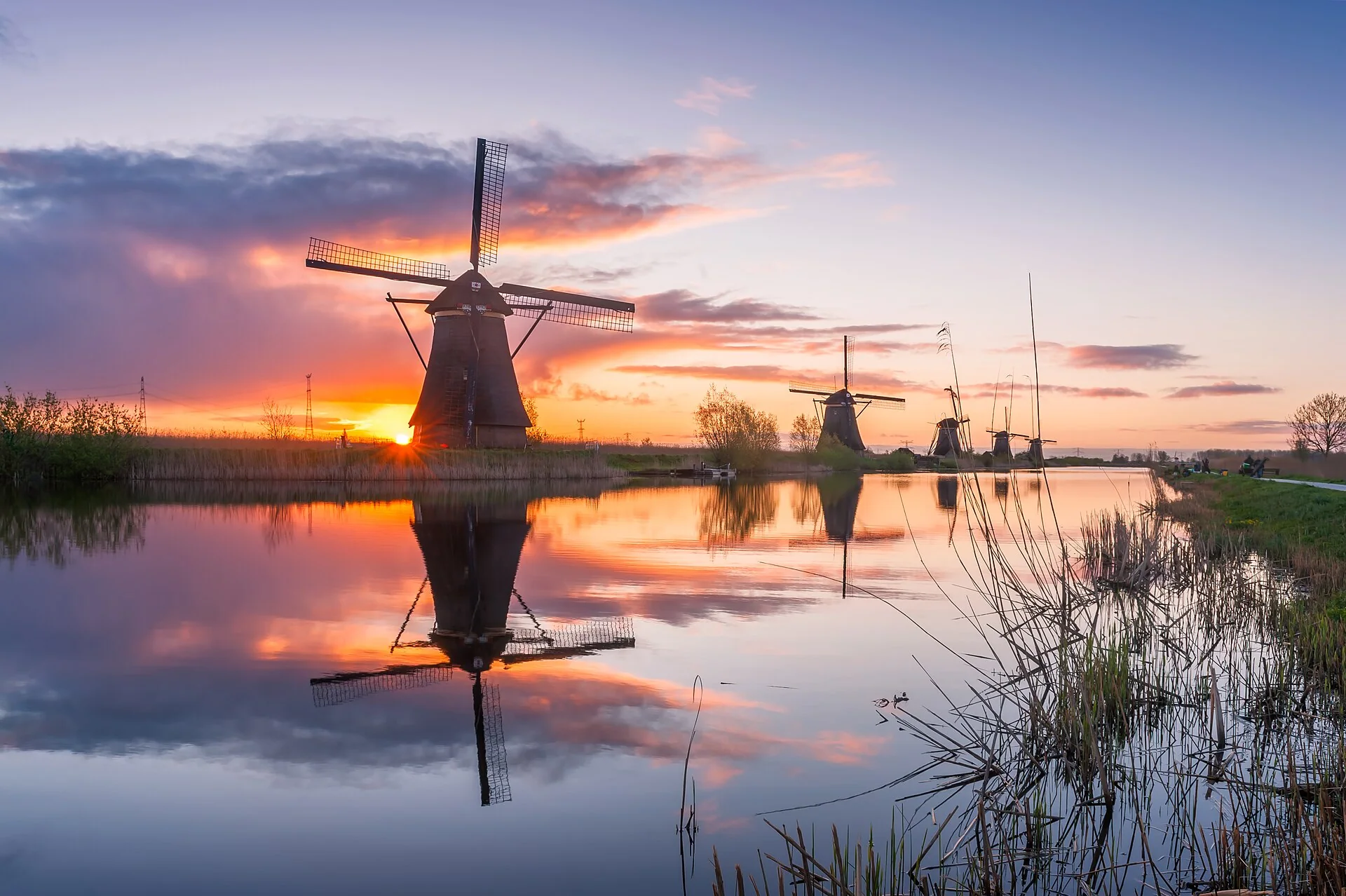
For many foreigners, nothing captures the idea of the Netherlands more vividly than windmills, wooden shoes, tulips, and remarkably flat lands. Although some of these characteristics have evolved into stereotypes far off from the daily lives of Dutch people, there's still a lot of truth to them and plenty of authenticity to be found. The Dutch have preserved many elements from this part of their past, both for tourism and for historic reasons.
The Dutch monarchy has several palaces. Kinderdijk boasts a network of 19 windmills, once used to drain the adjoining polder. The Zaanse Schans has windmills as well, and a nice museum with traditional crafts and old Dutch houses on display. Schiedam , world-famous for its jenever , has the tallest windmills in the world, and they're right in its lovely old town centre.
Thinking about the Dutch countryside, you might imagine wide, flat, grasslands with black and white cows. If you do, you're not that far off. A large swathe of the country, especially the western part of it, consist of polders; reclaimed land separated by ditches. These rural areas are sometimes dotted with villages, old farms, and of course, windmills; the Zaanstreek-Waterland is especially scenic. For a touch of folklore, see the traditional clothing and fishermen boats in Volendam or Marken . You can go to the Zuiderzeemuseum in the city of Enkhuizen , or Openluchtmuseum in Arnhem for a touch of traditional Dutch life in bygone times. They are not nearly as overcrowded as Zaanse Schans, are specifically made for tourists and offer more. Both are open air museums, so don't forget to check the weather before you go.
Experiences
18 clubs play in Eredivisie the top tier, and three have traditionally dominated: Ajax in Amsterdam, Feyenoord in Rotterdam and PSV in Eindhoven. 20 clubs play in Eerste Divisie and 18 in the semi-pro Tweede Divisie.
Cycling is popular, which makes sense given how flat the country is. Nowadays, the Netherlands boasts 22,000 km of dedicated cycle paths, forming a dense web across the country. If you do decide to cycle, you'll notice just how easy it is: the numbered routes and multitude of signposts means it's almost impossible to get lost! There are also plenty of areas well-suited for scenic cycling, including the Green Heart , Hoge Veluwe National Park , South Limburg , and the Zaanstreek-Waterland . Winds can be strong (because of the flat lands), and winters can be cold and rainy.
There is no shortage of beaches along the 1,245 km of Dutch coastline. Popular activities include swimming and sunbathing , but these are mostly restricted to warm summer days. Expect Scheveningen to be extremely crowded when temperatures rise towards tropical levels. More mellow and family friendly beaches include Zandvoort , Bloemendaal , Bergen , Noordwijk, Katwijk and the West Frisian Islands . Texel also has some beautiful beaches, but be careful; some beaches are reserved for nature and it is strictly forbidden to enter those.
Culture and food
The Netherlands is not known for its cuisine, as it is simple and straightforward. A conventional Dutch meal consists of meat, potatoes and some type of vegetable on the side. The country's food culture is best described as rustic. High in carbohydrates and fat, the country's food culture reflects the dietary need of farm laborers, but as society moved on to work in the services sector, its food culture has remained largely the same. The Dutch national dish is stamppot , potatoes mashed with one or several vegetables. The variety with endive and bacon is considered the most traditional. Hutspot is a variety with carrots and onions.
Planning your route
The Netherlands is served by an extensive public transport network, making this a good way to get around and discover the main sights. Motorists can rely on an extensive system of ( Auto)snelwegen (Highways/motorways) and Autowegen (semi-highways). Of course the Netherlands is known as one of the most bicycle-friendly countries in the world. A truly extensive bicycle infrastructure makes cycling an excellent way to get around.
Travel guide text compiled and adapted from Wikivoyage article (contributors). Sections were selected and reordered for this guide. Text is shared under CC BY-SA 4.0. Check current arrangements with your travel consultant.
Plan the full journey
Useful for this trip
This country’s visa guidance has not been fully verified against current official requirements. Confirm the application route for your passport, residence and purpose before making travel commitments.
Review details
Netherlands: Official pages were retrieved, but the complete imported guidance has not been corroborated claim by claim for Kenyan ordinary passports. Still to confirm: passport validity, tourist and business eligibility, application route, any exemptions and published processing guidance. Residents using other passports require a separate nationality check.