
Mongolia
Mongolia ( Mongolian : Монгол улс, Traditional Mongolian: ) has wide open spaces for experiencing the outdoors for those who want adventure. Its vast and majestic emptiness is the country's enduring appeal: it brings…
At a glance
Useful facts for planning
In this guide
Why go
Overview
Mongolia ( Mongolian : Монгол улс, Traditional Mongolian: ) has wide open spaces for experiencing the outdoors for those who want adventure. Its vast and majestic emptiness is the country's enduring appeal: it brings the traveller into a close communion with nature and its nomadic inhabitants. It is one of the last places on earth where nomadic life lives on. The most memorable part of a trip to Mongolia will be its hospitable people. Mongolian culture has much in common with the cultures of Central Asia .
Mongolia is one of the world's largest landlocked countries, second only to Kazakhstan and is surrounded by two of the world's largest countries: China and Russia . It was the center of the Mongol Empire , the largest contiguous empire in world history. With only 1.7 people per square kilometre, Mongolia has the lowest population density of any independent country.
The country is nicknamed the "Land of Blue Skies," and with good reason. There are said to be about 250 sunny days throughout each year. The weather is bitterly cold during the winter, dropping down to -40°C in some parts. With many types of terrain — from desert to verdant mountains — the weather during the summer varies from region to region, but is generally hot. Outside of the Gobi desert, this time of year is marked with much rain in some areas, and it can become quite cool at night.
Mongolia may have geopolitical, cultural and geographical meanings. Modern-day Mongolia consists of what was historically Outer Mongolia (so-called when it was part of China). Inner Mongolia is politically separate and remains a province of China, sharing a border and a common cultural heritage with modern-day Mongolia.
Sights and landscapes
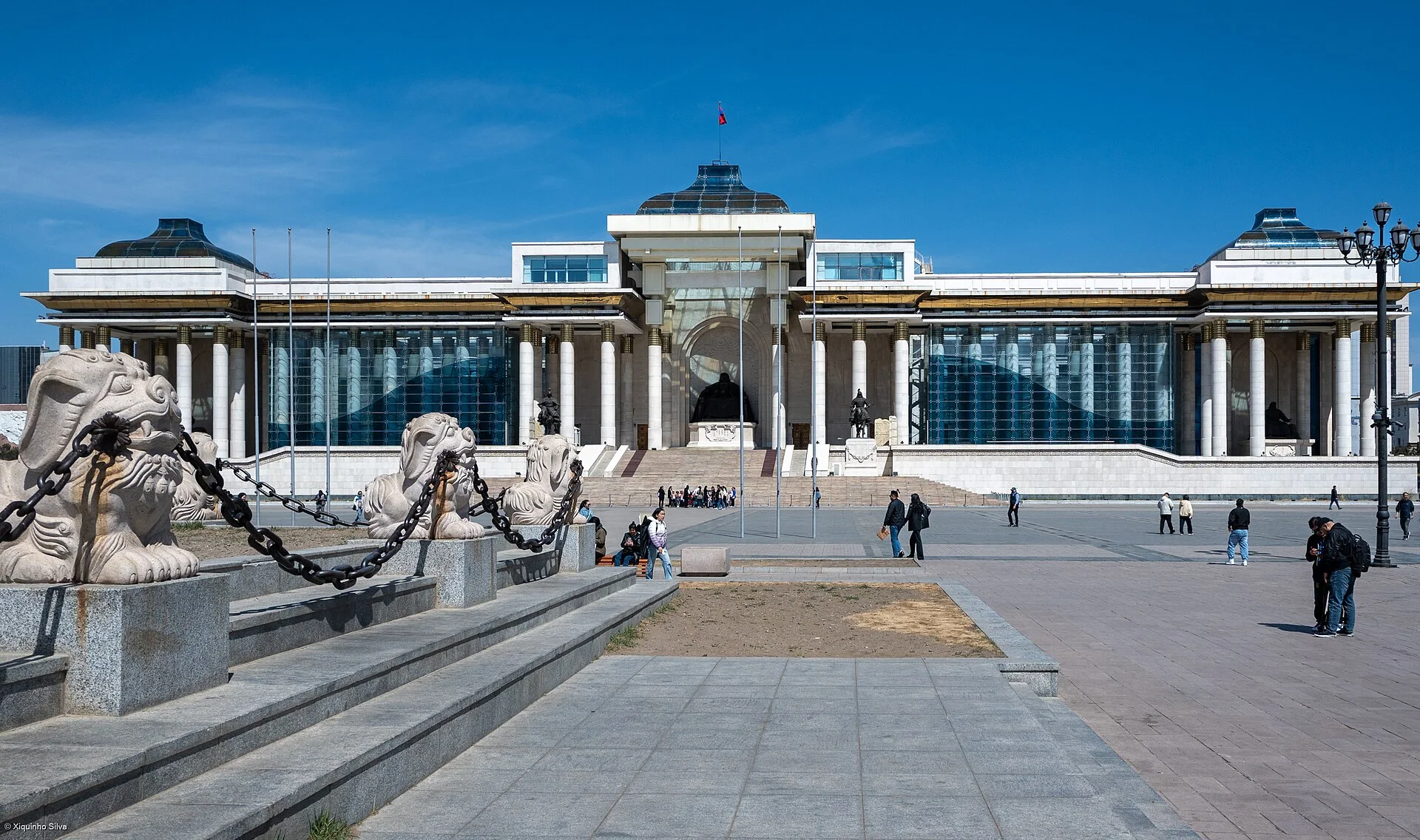
Mongolia is a big country that has been beyond the reach of travellers and the normal trappings of civilization until the 21st century. Even today it can be difficult to travel between the few places that 'exist'. There is little noteworthy architecture in the country. Except for the short-lived capital of the Mongol Empire at Karakorum (Kharkhorin) , the descendants of Genghis Khan left little evidence of their power inside their native homeland. Genghis Khan, who leveled cities from the Yellow Sea to the Caspian, was said to have only built one permanent building during his life, a warehouse to store his stupendous amount of loot.
Though this structure no longer exists, the capital built by his son, Ögedei, does, as do countless artifacts in the National Museum in Ulaanbaatar , and thousands of stone monuments and drawings spread throughout the country, some dating back thousands of years. After the gradual disintegration of the Mongol Empire, many Tibetan Buddhist monasteries were built, providing the most visible signs of Mongolia's history. Today only a few still stand after Stalinist religious purges. Of particular note is the Amarbaysgalant Monastery in Selenge, the Erdene Zuu Monastery in Kharkhorin, and Gandan Monastery in Ulaanbaatar, all active religious sites with large numbers of resident lamas. During the communist era, the Soviets helped establish large modern cities and modern industries, which aren't very pretty, but are of some interest, particularly the biggest open-pit copper mine in Asia at Erdenet .
Experiences
Experiencing the culture and having a meal or spending the night with a nomadic family are authentic Mongolian experiences. Whether you go just outside of the capital or fly to the far corners of the country, this is the most memorable part of any trip. There are some variations on the experience, depending on the tribal group.
The Trans-Siberian Railway passes through the country. Also follow the path of Marco Polo across Europe and Asia into Mongolia to visit the ancient capital of the Mongol Empire in Karakorum .
Mongolia is the least densely populated country in the world and has very little development of any kind outside of the capital and a few small towns. There often aren't even roads connecting these towns. This pristine setting means that Mongolia has wide open spaces for experiencing the outdoors for those who want adventure. Traveling across this vast country is often an adventure in itself with tourists and adventurers alike going by car, motorcycle, bike, horse, camel, or foot. Most often this means camping on the shore of a river or with a nomadic family or in small roadside hotels in provincial towns. Along the way or on one of the many wild rivers and nature preserves, there is great fishing, particularly fly-fishing during the summer. Climbing the mountains in the west is popular as well as photographing the wildlife, flora, or the multitude of birds living or migrating through Mongolia.
Culture and food
Anywhere you find people in Mongolia, you will also smell the scent of boiled mutton , the principal dish of Mongolia. A typical herder in the countryside will eat little else, flavored only with a little salt. Vegetables and spices are very limited, and even flour may be in short supply, since the climate is poorly suited to agriculture.
Horse, yak and beef are also eaten, and dairy products like byaslag (бяслаг), a mild, paneer-like fresh cheese, and öröm (өрөм), clotted cream, are also common. Aaruul (ааруул) dried curds are also a common snack: these are typically rock hard and have to be eaten by slowly dissolving them in your mouth, which eventually turns them into lumps of cheesy putty.
Planning your route
There are many places with the same name in Mongolia, so finding your way can be tricky. It is much easier to refer to a place with for aimag names, then soum names, then only city/village name. For example, Ulaangom is the capital of Uvs , so buses will indicate the latter. Once in an aimag you may refer to a soum, and only then to the city name.
Travel guide text compiled and adapted from Wikivoyage article (contributors). Sections were selected and reordered for this guide. Text is shared under CC BY-SA 4.0. Check current arrangements with your travel consultant.
Plan the full journey
Useful for this trip
This country’s visa guidance has not been fully verified against current official requirements. Confirm the application route for your passport, residence and purpose before making travel commitments.
Review details
Mongolia: Official pages were retrieved, but the complete imported guidance has not been corroborated claim by claim for Kenyan ordinary passports. Still to confirm: passport validity, tourist and business eligibility, application route, any exemptions and published processing guidance. Residents using other passports require a separate nationality check.