
Mali
A landlocked country in the Sahel , Mali remains one of the poorest countries in the world, but it has wonderful musicians and some incredible sights, including four UNESCO World Heritage sites and the…
At a glance
Useful facts for planning
In this guide
Why go
Overview
A landlocked country in the Sahel , Mali remains one of the poorest countries in the world, but it has wonderful musicians and some incredible sights, including four UNESCO World Heritage sites and the historic city of Timbuktu .
The Sudanese Republic and Senegal became independent of France on 22 Sept 1960 as the Mali Federation. Senegal withdrew after only a few months, and the Sudanese Republic was renamed Mali. The country was then governed by dictatorships until 1991. In 1992 the country's first democratic presidential elections were held, but since then, Mali has regressed back into a military regime embroiled in a civil war with Islamist militants and Tuareg separatists.
Just under half the population is less than 15 years old. The great majority of Malians are Muslim, some also practice indigenous beliefs, and a tiny number are Christian. Around 10% of the population is nomadic. Most Malians work in agriculture and fishing.
Mali was once part of three famed West African empires which controlled trans-Saharan trade in gold, salt, slaves, and other precious commodities. These Sahelian kingdoms had neither rigid geopolitical boundaries nor rigid ethnic identities. The earliest of these empires was the Ghana Empire which expanded throughout West Africa from the 8th century until 1078.
Sights and landscapes
The Great Mosque of Djenné , built in 1907, is made completely of mud, and it has five stories and three towers. Every spring the people replaster the Mosque. Regrettably, entrance to non-Muslims is not allowed. Apparently this prohibition is a consequence of a fashion photo-shoot held by Vogue inside the mosque in 1996, which was regarded by the locals as "pornographic".
Mali is a landlocked country in West Africa . It lies between latitudes 10° and 25°N and longitudes 13°W and 5°E . Mali borders Algeria to the north-northeast , Niger to the east , Burkina Faso to the southeast , Ivory Coast to the south , Guinea to the south-west , and Senegal to the west and Mauritania to the north-west .
At 1,240,192 square kilometres (478,841 sq mi), Mali is the 24th-largest country in the world and the eighth-largest country in Africa . Most of the country lies in the southern Sahara Desert, which produces an extremely hot, dust-laden Sudanian savanna zone. Mali is mostly flat, rising to rolling northern plains covered by sand. The Adrar des Ifoghas massif lies in the northeast.
Mali lies in the torrid zone and is among the hottest countries in the world. The thermal equator (which matches the hottest spots year-round on the planet based on the mean daily annual temperature) crosses the country. Most of Mali receives negligible rainfall, and droughts are very frequent. Late April to early October is the rainy season in the south. During this time, flooding of the Niger River is common, creating the Inner Niger Delta . The vast northern desert has a hot desert climate ( Köppen climate classification BWh ) with long, extremely hot summers and scarce rainfall which decreases northwards. The central area has a hot semi-arid climate (Köppen climate classification BSh ) with very high temperatures year-round, a long, intense dry season and a brief, irregular rainy season. The southern areas have a tropical wet and dry climate (Köppen climate classification Aw ).
Culture and food
The most universal Malian dish is rice with sauce, often peanut "tiga diga na," tomato/onion/oil or leaf/okra based which is usually served some fish or meat if purchased or prepared for guests. "To", a gelatinous corn or millet food served with sauce, is another Malian classic, though more a village food than something most tourists would encounter. In the north, couscous is also quite common.
In the largest cities, decent "western" restaurants can be found, charging near western prices. Bamako even has good Chinese, Vietnamese, Italian, Lebanese and more. In smaller places, the standard Malian restaurant serves chicken or beef with fries and/or salad – usually edible and affordable, but boring and not particularly Malian. The better places in the more touristy areas may also have some local specialities. "Street food" is a lot more fun and cheaper: breakfast will be omelet sandwiches, lunch is usually rice with a couple of sauces to choose from, and dinner presents many options including beans, spaghetti cooked in oil and a little tomato, potatoes, fried rice, chicken, meatballs, beef kebabs, fish and salad. You can find little tables along the roadsides and near transport centers.
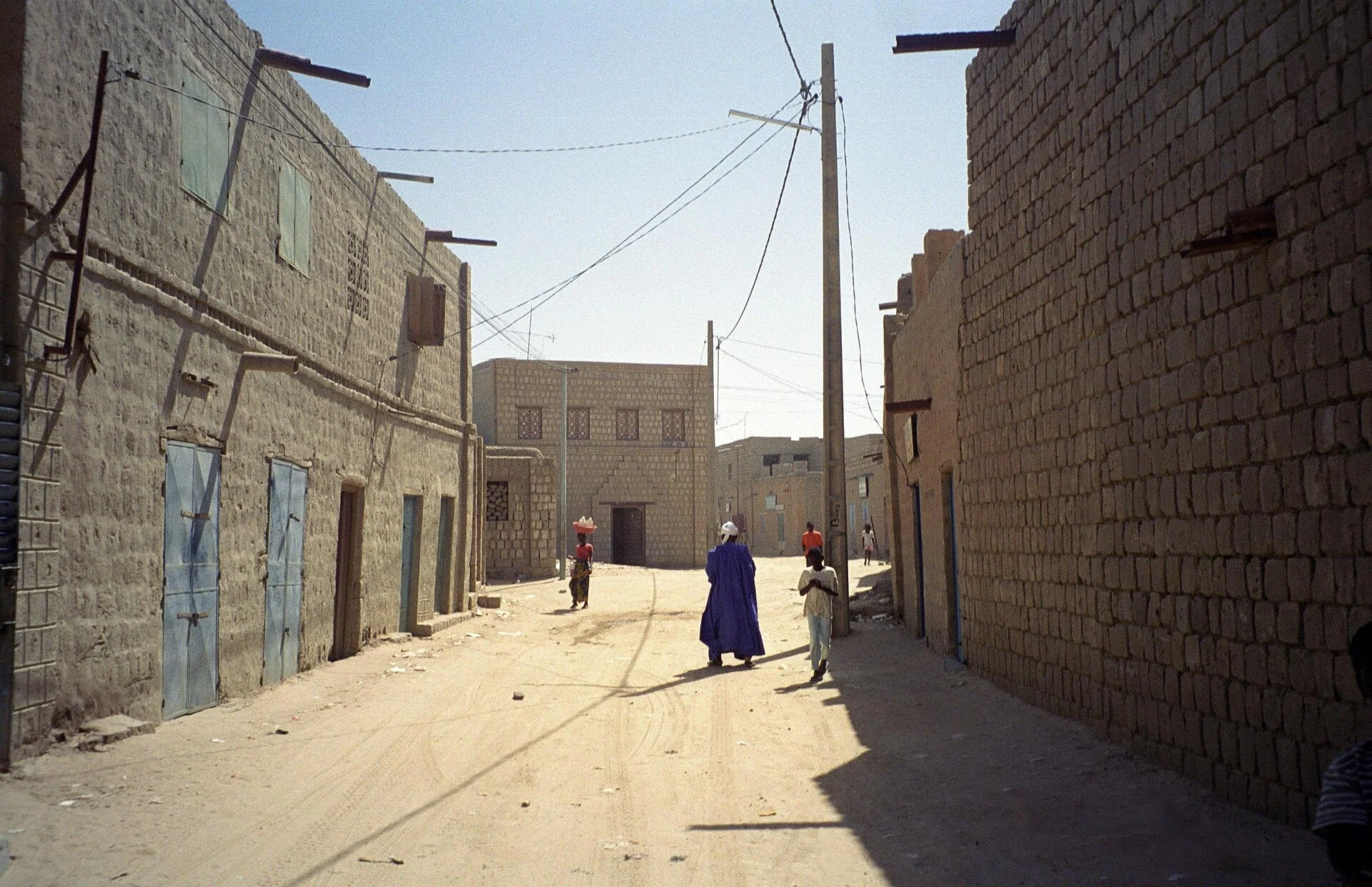
The varied everyday culture of Malians reflects the country's ethnic and geographic diversity. Most Malians wear flowing, colorful robes called boubous that are typical of West Africa. Malians frequently participate in traditional festivals, dances, and ceremonies.
Planning your route
The main cities along the paved road into the north are connected via bus (Bamako, Segou, San, Mopti, Gao). A separate paved loop runs through the south (Bamako, Bougouni, Sikasso, Koutiala, Segou) There are many different companies with different schedules but they all have more or less the same prices. Normally a ride to Mopti (600 km, half the way up), endures approximately nine hours; a ride to Gao at least 12. All times are very rough, however, and few bus companies will even give you an estimated arrival time as different drivers drive different speeds and it is not improbable that the bus breaks down and needs a repair or stops to help another bus. It is usually possible to make a reservation several days before, recommended during the tourist season, though one rarely has a problem just showing up 30-60 minutes before the bus leaves. More reliable companies include Bittar, Bani and Banimonotie (Sikasso region) among others.
Travel guide text compiled and adapted from Wikivoyage article (contributors) and Wikipedia article (contributors). Sections were selected and reordered for this guide. Text is shared under CC BY-SA 4.0. Check current arrangements with your travel consultant.
Plan the full journey
Useful for this trip
This country’s visa guidance has not been fully verified against current official requirements. Confirm the application route for your passport, residence and purpose before making travel commitments.
Review details
Mali: The supplied sources could not provide sufficient readable official guidance during this assessment. 1 source link(s) could not be retrieved successfully; see the source log. Still to confirm: passport validity, tourist and business eligibility, application route, any exemptions and published processing guidance. Residents using other passports require a separate nationality check.