
Guinea-Bissau
A former Portuguese colony, Guinea-Bissau, independent since 1974, has had an arduous history of coups and political crises. This small nation has a variety of tropical forests and vibrant Afro-Latin culture.
At a glance
Useful facts for planning
In this guide
Why go
Overview
A former Portuguese colony, Guinea-Bissau, independent since 1974, has had an arduous history of coups and political crises. This small nation has a variety of tropical forests and vibrant Afro-Latin culture.
Guinea-Bissau was once part of the kingdom of Gabu, part of the Mali Empire; parts of this kingdom persisted until the eighteenth century. Early reports of Europeans reaching this area come from 1456 CE. The rivers and coast of this area were among the first places colonized by the Portuguese from 1588 onward, but the interior was not explored by Europeans until the 19th century.
The Portuguese tried desperately to hang on to their colony much longer than other European countries. An armed independence rebellion began in 1956, but it was not until 1974 that the Portuguese finally accepted independence for Guinea-Bissau.
Guinea-Bissau is warm all year around and there is little temperature fluctuation; it averages 26.3°C (79.3°F). The average rainfall for Bissau is 2,024 mm although this is almost entirely accounted for during the rainy season which falls between June and September/October. From December to April, the country experiences drought.
The ethnic groups in Guinea-Bissau include Fula and Mandinka in the north and northeast, the Balanta and Papel in the southern coastal regions, and the Manjaco and Mancanha in the northern and central coastal areas.
Culture and food
Most Guineans eat rice with fish, because the country is rich in fish, and rice (homegrown or imported from Thailand) is relatively cheap. The more costly meals contain beef, goat, chicken or pork. Meals are also made with palm oil and peanut sauce and vegetables. Guineans also eat wild game (deer, monkey, beaver etc.) but these animals are endangered and so it is not recommended to support this.
Guineans are known for their warm-heartedness and so you will always be asked to come eat with a group of people (it is common to eat from a large bowl)… "bin kume, no kume".
Fruit available depends on the season, but mangos, papayas, oranges, grapefruits, bananas, cashews and peanuts are abundant. Also try the sour "fole" fruits and baobab fruit juice (sumo de cabaceira). Imported fruit can be bought in "fera de prasa" in the centre of Bissau (apples, pears, pineapples, watermelons, etc.), but it is more expensive than in Europe.
The people of Guinea-Bissau love to drink a sweet green tea known as "warga". Non-Muslims also enjoy drinking cashew wine or palm wine. You can also buy Portuguese beer, wine and soft drinks, but these are more expensive. It is recommended that foreigners only drink bottled, filtered or boiled water.
The music of Guinea-Bissau is usually associated with the polyrhythmic gumbe genre , the country's primary musical export. However, civil unrest and other factors have combined over the years to keep gumbe, and other genres, out of mainstream audiences, even in generally syncretist African countries.
The calabash is the primary musical instrument of Guinea-Bissau, and is used in extremely swift and rhythmically complex dance music . Lyrics are almost always in Guinea-Bissau Creole , a Portuguese -based creole language , and are often humorous and topical, revolving around current events and controversies.
Common dishes include soups and stews . Common ingredients include yams , sweet potato , cassava , onion, tomato, and plantain . Spices, peppers, and chilis are used in cooking, including Aframomum melegueta seeds (Guinea pepper).
Planning your route
In Bissau minibuses called toca-toca work for transports within the city. There are also regular taxis . For inter-city travel there are sept-places , (seven-seat Peugeot) and candongas , big commercial vehicles carrying ten to twenty passengers. Prefer sept-place or at least try to get the front seats. It is also possible to rent taxis to other towns and cities.
The main bus-station "paragem" of Bissau is behind the BCEAO (Banco Central dos Estados de África Ocidental) on the Airport Road. Are you heading for Biombo or Prabis, you need to go to another bus-station in Estrada de Bor. There are no time-schedules; cars leave when they are full. As most locals travel in the early morning (07:00-ish), cars fill up quicker in the morning. It might be hard to get transport in late afternoon and evening.
Sights and landscapes
Guinea-Bissau is bordered by Senegal to the north and Guinea to the south and east, with the Atlantic Ocean to its west. It lies mostly between latitudes 11° and 13°N (a small area is south of 11°), and longitudes 11° and 15°W .
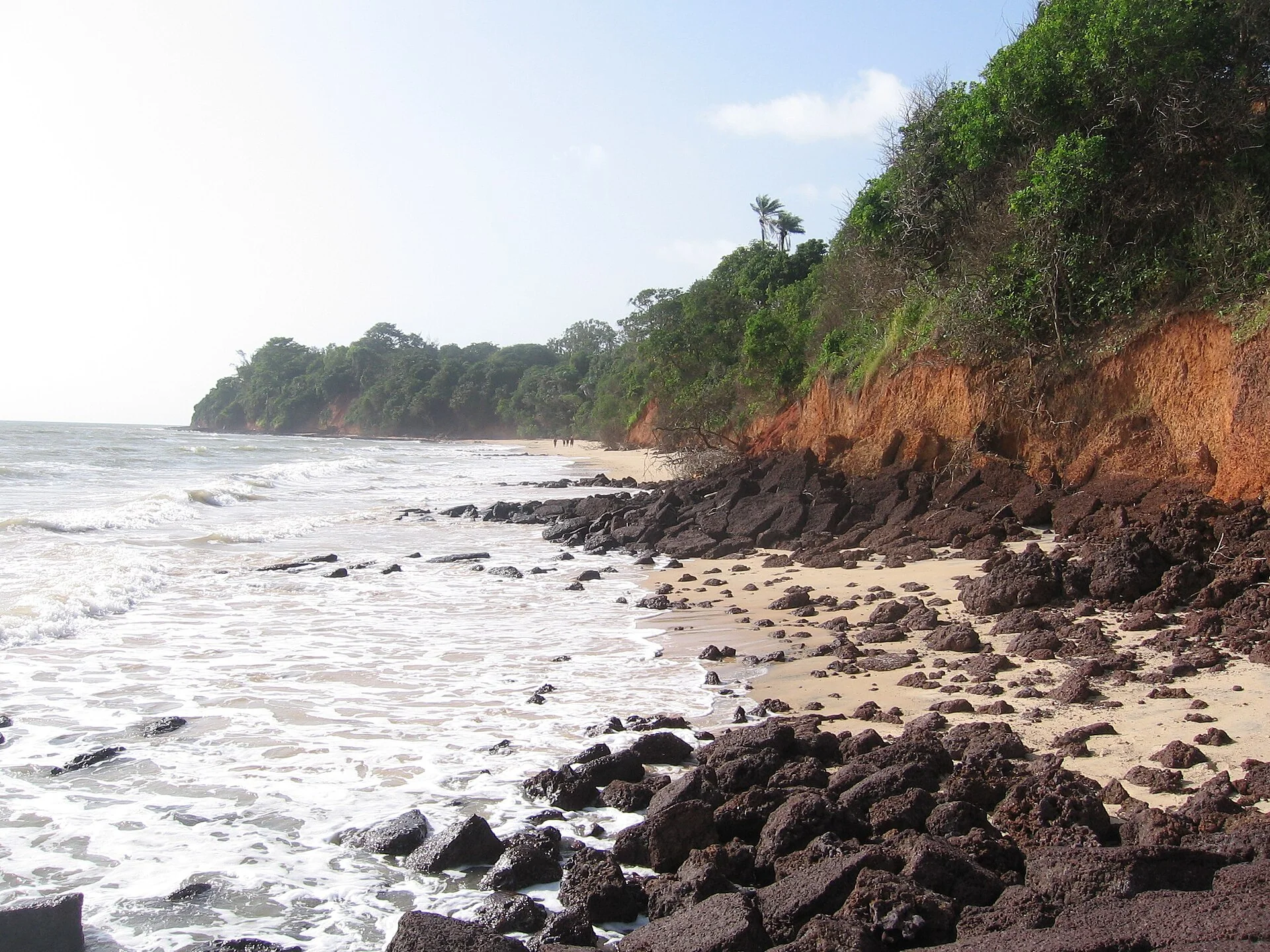
At 36,125 square kilometres (13,948 sq mi), the country is larger in size than Belgium . The highest point is Monte Torin with an elevation of 262 metres (860 ft). Its terrain is mostly low coastal plains with swamps of the Guinean mangroves rising to the Guinean forest–savanna mosaic in the east. Its monsoon -like rainy season alternates with periods of hot, dry harmattan winds blowing from the Sahara . The Bijagós Archipelago , comprising 88 islands and islets, lies off of the mainland. The country is home to two ecoregions: Guinean forest–savanna mosaic and Guinean mangroves.
Guinea-Bissau is warm all year with mild temperature fluctuations; it averages 26.3 °C (79.3 °F). The average rainfall for Bissau is 2,024 millimetres (79.7 in), although this is almost entirely accounted for during the rainy season which falls between June and September/October. From December through April, the country experiences drought.
Travel guide text compiled and adapted from Wikivoyage article (contributors) and Wikipedia article (contributors). Sections were selected and reordered for this guide. Text is shared under CC BY-SA 4.0. Check current arrangements with your travel consultant.
Plan the full journey
Useful for this trip
This country’s visa guidance has not been fully verified against current official requirements. Confirm the application route for your passport, residence and purpose before making travel commitments.
Review details
Guinea-Bissau: The supplied sources could not provide sufficient readable official guidance during this assessment. 1 source link(s) could not be retrieved successfully; see the source log. Still to confirm: passport validity, tourist and business eligibility, application route, any exemptions and published processing guidance. Residents using other passports require a separate nationality check.