
Eswatini
The Kingdom of Eswatini , formerly (and still commonly) known as Swaziland , is a landlocked country in Southern Africa and is informally known as "Africa in a nutshell".
At a glance
Useful facts for planning
In this guide
Why go
Overview
The Kingdom of Eswatini , formerly (and still commonly) known as Swaziland , is a landlocked country in Southern Africa and is informally known as "Africa in a nutshell".
Cushioned between South Africa and Mozambique and Africa's last standing absolute monarchy, Eswatini is one of Africa's smallest countries, attracting up to a million visitors each year. With a population of around 1.2 million, it is also one of Africa’s least populated countries. It is endowed with breathtaking national parks, mesmerising scenery, and lots of wildlife.
Swazis build their huts depending on whether they are descended from Nguni or Sotho: Nguni huts are beehive in shape; Sotho huts have window frames and full doorways. Living space is roughly divided into three parts: living accommodation, animal housing and the 'great' hut, reserved for the spirits of the patrilineal ancestors. Each chief's wife has her own hut. Land is owned by local chiefs or the Crown; much land has been bought back for the nation and unclaimed spaces are used for grazing and collection of firewood. There is a growing class system due to the expansion of the middle classes. Social rank can be determined through the individual's relation to the head of their clan or to the royal family. In urban areas, fluency and proficiency in English is the main social delineator.
Culture and food
Maize-based dishes are popular, and mealie or pap (similar to porridge) is a staple. Beans, groundnuts, pumpkin, avocado and sour milk are also common ingredients. Dried and cooked local meats, such as antelope (often called 'wild meat' by locals), are widely available at tourist restaurants.
"Chicken dust" is a cheap local bbq meal; basically chicken grilled in the open served with a salad and mealie. It is popular both with locals and delicious. Take appropriate precautions as it is a street vendor food.
Sweet breads, vegetables and fruits are often available from roadside merchants. If you're craving pasta, imported olive oil, Nestle chocolate, Herbal Essences and Carlsberg, go to the Hub, at Manzini: a huge Spar with everything you could need (at an appropriately inflated price). There are several coffee-shops and restaurants around the Hub, also: be aware that the lavatories are located separately, down the stairs, and you have to pay to use them. Manzini's bustling markets and local shops yield all kinds of interesting foodstuffs, along with the ubiquitous KFC.
Marula (made of fruits from the tree with the same name) is locally brewed during the marula season, fruits ripen between December and March. It may be difficult to find; ask locals as it is home-brewed.
Planning your route
With an area of 6,704 sq mi, the quickest way to get around the country is by car. You can easily cover the whole country in one day this way.
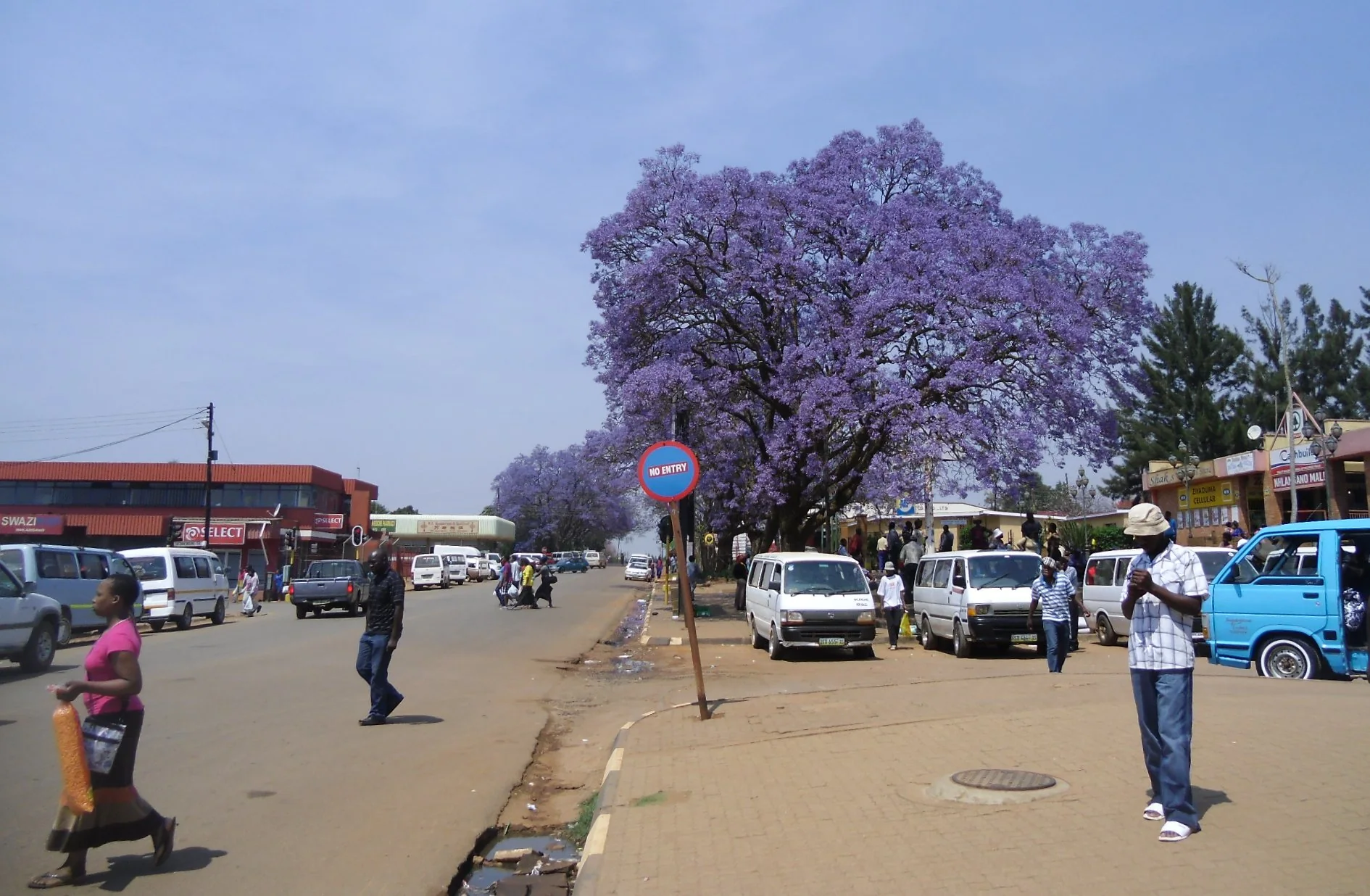
Minibuses, called kombis, are prevalent, but can be confusing. Like similar modes of travel around the world such as the jitney, matatu or dolmus, these are small vans that accumulate as many travellers as possible while making their way along a general direction. In Eswatini, these vans are often driven by young men, and most have assistants who estimate and collect fares, ask your destination, and give change. You are unlikely to be over-charged.
Sights and landscapes
A small landlocked kingdom with an area of 17,364 km 2 (6,704 sq mi), Eswatini is located at roughly 26°30'S, 31°30'E and is bordered in the north, west, and south by South Africa and by Mozambique in the east. Along the eastern border with Mozambique are the Lebombo Mountains , a mountain ridge at an altitude around 600 metres (2,000 ft). The mountains are broken by the canyons of three rivers, the Ngwavuma , the Great Usutu , and the Mbuluzi . The western border, with an average altitude of 1,200 metres (3,900 ft), lies on the edge of an escarpment .
Eswatini is divided into four climatic regions: the Highveld, Middleveld, Lowveld, and Lubombo plateau. Generally speaking, rain falls mostly during the summer months (December to March), often in the form of thunderstorms. Winter is the dry season . Annual rainfall is highest on the Highveld in the west, between 700 and 1,550 mm (27.6 and 61.0 in). The further east, the less rain, with the Lowveld recording 200 to 550 mm (7.9 to 21.7 in) per annum. Variations in temperature are also related to the altitude of the different regions. The Highveld temperature is temperate and seldom uncomfortably hot, while the Lowveld may record temperatures around 40 °C (104 °F) in summer.
Eswatini has a spectrum of formal and informal conservation areas that protect the nation's rich biological diversity. These areas comprise about 5% of the country's land area. Eswatini has over 820 species of vertebrates and over 2,400 species of plants, with many endemic species. This diversity suggests Eswatini is globally important for biodiversity conservation. Land degradation and conversion to other land uses are the major threats to biodiversity, including plantation agriculture (legal and illegal), bush-clearing, the spread of alien and invasive plants, and unsustainable resource harvesting; major land fragmentation is evident.
There are six formal and more than 10 informal protected areas in the country. The formally gazetted areas include: Malolotja Nature Reserve , Mantenga Nature Reserve, Mlawula Nature Reserve , Mlilwane Wildlife Sanctuary , and Mkhaya Game Reserve , and Hlane Royal National Park . In addition to these, there are many private and community nature reserves, as well as some with mixed governance structures. These include: Dombeya Game Reserve, Mbuluzi Game Reserve , Shewula Nature Reserve, Phophonyane Falls Nature Reserve , Royal Jozini , IYSIS (Inyoni Yami), Ngwempisi Wilderness, Sibebe and others. There are other entities that practice secondary or tertiary conservation, as well as two conservancies: the Mhlosinga Conservancy and the Lubombo Conservancy . Others include: the Natural History Society of Eswatini and the Eswatini Game Ranchers Association.
Travel guide text compiled and adapted from Wikivoyage article (contributors) and Wikipedia article (contributors). Sections were selected and reordered for this guide. Text is shared under CC BY-SA 4.0. Check current arrangements with your travel consultant.
Plan the full journey
Useful for this trip
This country’s visa guidance has not been fully verified against current official requirements. Confirm the application route for your passport, residence and purpose before making travel commitments.
Review details
Eswatini: The supplied sources could not provide sufficient readable official guidance during this assessment. 2 source link(s) could not be retrieved successfully; see the source log. Still to confirm: passport validity, tourist and business eligibility, application route, any exemptions and published processing guidance. Residents using other passports require a separate nationality check.