
Benin
Benin is a country in West Africa . You'll find culture through a large collection of palatial ruins and temples of the once powerful Kingdom of Dahomey (1800s–1894). Moreover, Benin is the birthplace of…
At a glance
Useful facts for planning
In this guide
Why go
Overview
Benin is a country in West Africa . You'll find culture through a large collection of palatial ruins and temples of the once powerful Kingdom of Dahomey (1800s–1894). Moreover, Benin is the birthplace of Vodun (Voodoo) and all that goes with it. Vodun is the official religion of the country, and an important part of the life of ordinary Beninese. Many important tourist sites are linked to Vodun or the slave trade. The national parks of Benin are well worth a visit for their wildlife. It is also one of the most stable and safest countries in the region. With its rich history, vibrant culture, protected wildlife, Grand Popo ocean beach, and artisan market in Se, Benin is one of the best kept tourist secrets in West Africa.
Benin, known as Dahomey until 1960, was one of the few countries to transition from Marxist rule to a democratic system in the 1990s. The country enjoys an island of stability and provides a complex heritage, handful of spiritual traditions and endless tropical landscapes.
To understand the roots of Benin, you must look at the Kingdom of Dahomey, whose origin story begins with the Adja of present-day Togo. Around the 12th or 13th century, the Adja people of Tado, a village on the banks of the Mono River, migrated to present-day Benin. Fighting for succession among three brothers split the Adja in the early 17th century. The brothers divided the territory and founded their own kingdoms. Kokpon founded the Kingdom of Allada, Te-Agdanlin founded the Kingdom of Hogbonou, which the Portuguese later named Porto-Novo, and Do-Aklin founded the Kingdom of Abomey, which would soon be known as Dahomey.
Sights and landscapes
Benin is perhaps best known to the world as the birthplace of the Vodun religion, or voodoo. Voodoo temples, roadside fetishes and fetish markets are found throughout the country, but the best known is the skull and skin-filled fetish market in the Grande Marche du Dantopka, which is Cotonou 's overwhelmingly busy, enormous and hectic grand market.
Ganvie , just north of Cotonou and accessible by boat from Abomey-Calavi is home to 30,000 people, whose ancestors fled the brutal Dahomey kings by building their town on stilts in the center of Lake Nokoué. Ganvie is without question a fascinating and naturally beautiful locale, and a popular stop as one of the largest of West Africa's lake towns.
Benin under the rule of the Dahomey kings was a major center of the slave trade, and the Route des Esclaves in Ouidah , terminating at the beachside Point of No Return monument is a memorial to those who were kidnapped, sold, and sent off to the other side of the world. Ouidah's local history museum, housed in a Portuguese fort, focuses on the slave trade in addition to other facets of local culture, religion, and history, and is a real must see for anyone passing through the country. As many towns, Ouidah has its own Sacred Forest, where guided tours on part of the grounds are given and different voodoo beliefs are explained; the other part of the grounds houses a convent for initiates and is closed to the public.
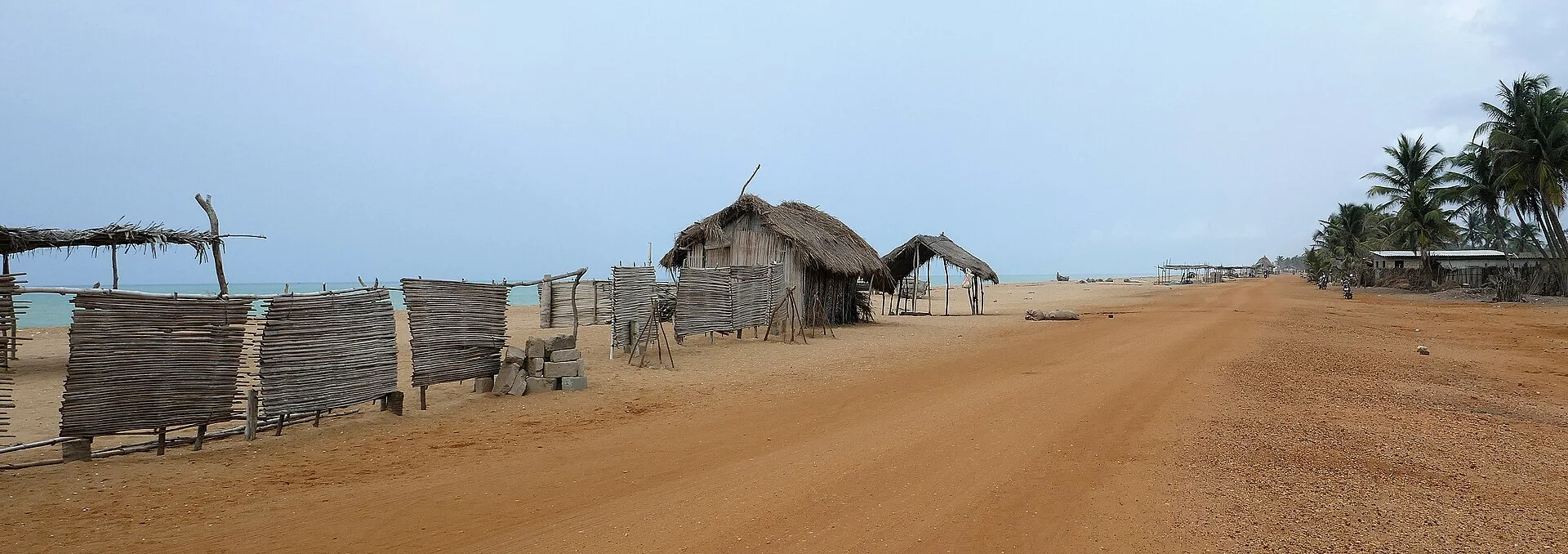
Continuing westwards from Ouidah towards Togo lies Grand Popo , a relaxed seaside town, often used for conferences and events. Grand Popo offers boat trips to the Bouche du Rois , the point where the Mono river meets the ocean, past mangroves, villages, birds and fishermen.
A very short trip north-east of Porto Novo lies the village of Adjarra and the Black River ( riviere noire ), a slow-flowing body of water surrounded by lush vegetation with only traditional and engine-less wooden boats crossing it.
Abomey was the capital of the Dahomey Kingdom, and its ruined temples and royal palaces , now a UNESCO World Heritage site, are one of the country's top attractions. The ruins, their bas-reliefs, and the Abomey Historical Museum in the royal palace (which contains all sorts of macabre tapestries and even a throne of human skulls) are a testament to the wealth brought to the Dahomey kings from the slave trade, and brutality with which they oppressed their enemies, fodder for human sacrifice and bondage.
Culture and food
In every city/village one will find street vendors selling anything from beans and rice to grilled chicken, goat and turkey. Prices are nominal. But one must be careful, always choose a vendor whose food is still hot, and they have taken care to keep the bowls covered with a lid or a cloth.
Planning your route
There is an extremely timely and reliable bus system that typically operates a tour-style bus through every major city in Benin every day, and even some international services in and out of Benin. There are many major lines with a range of quality of buses. The main systems are Confort Lines and Benin-Routes . Confort Lines seems to provide more of a variety of routes, and you even get some water and a little sandwich for long trips. Reservations for Confort Lines can be made in advance for CFA 500 at any regional office or by calling +229 21-325815. Bus lines run through: Porto-Novo, Cotonou, Calavey, Bohicon, Dassau, Parakou, Djougou, Natitingou, Tanguieta, Kandi, and even all the way up to Malanville.
Travel guide text compiled and adapted from Wikivoyage article (contributors). Sections were selected and reordered for this guide. Text is shared under CC BY-SA 4.0. Check current arrangements with your travel consultant.
Plan the full journey
Useful for this trip
This country’s visa guidance has not been fully verified against current official requirements. Confirm the application route for your passport, residence and purpose before making travel commitments.
Review details
Benin: Official pages were retrieved, but the complete imported guidance has not been corroborated claim by claim for Kenyan ordinary passports. Still to confirm: passport validity, tourist and business eligibility, application route, any exemptions and published processing guidance. Residents using other passports require a separate nationality check.