Slovenia
After World War II, Slovenia became a republic in the reestablished Yugoslavia, which made small territorial gains from Italy. Although communist, Yugoslavia left the Soviet bloc in 1948.
At a glance
Useful facts for planning
In this guide
Why go
Overview
After World War II, Slovenia became a republic in the reestablished Yugoslavia, which made small territorial gains from Italy. Although communist, Yugoslavia left the Soviet bloc in 1948.
Slovenia lies at the tripoint of the Germanic, Latin, and Slavic cultures, and Slovenes are fiercely proud of their culture. Two names you will run into over and over again are national poet France Prešeren (1800-1849), who penned (among other things) the Slovenian national anthem, and the architect Jože Plečnik (1872-1957), credited with Ljubljana's iconic Tromostovje bridges and, seemingly, half the modern buildings in the country. It was the monks of the Catholic Church that kept Slovene alive over the centuries of relentless Germanization from the north. As a result Slovene survived in its unique form different than Serbo-Croatian to the south. Part of both the countryside and city architecture in the Julian Alps shares a lot in common with neighboring Austria, including countless roadside shrines and pretty baroque steeples, giving the interior of the nation a truly Alpine flavor. One could easily mistake parts of mountainous Slovenia for Tyrol, Salzburg or Bavaria. In modern times, industrial band Laibach (see box) has served to put Slovenia on the map. In the decades before them, Slavko Avsenik and his Oberkrainer (as known in German) did the same.
Sights and landscapes
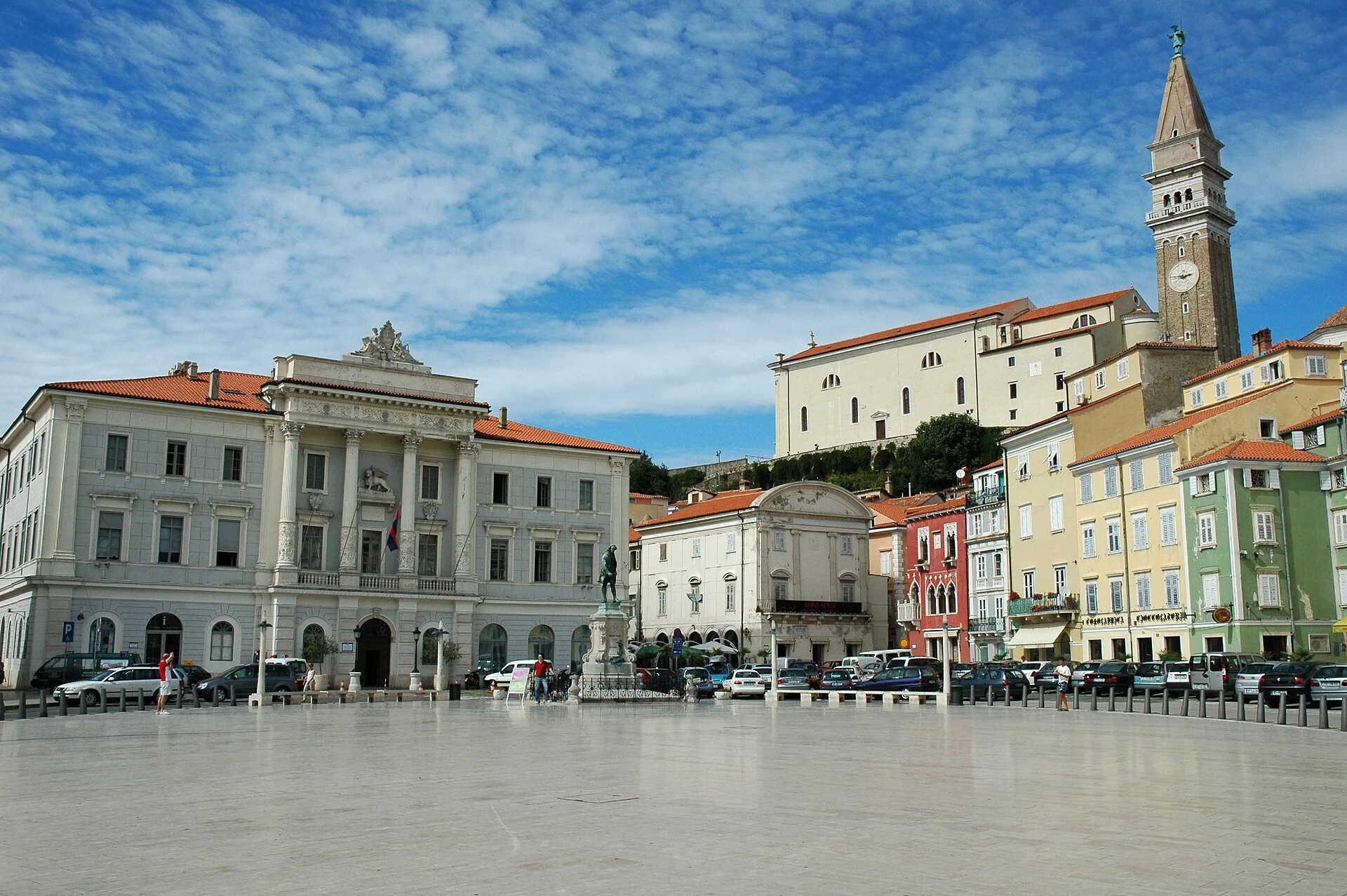
Slovenian cities leave no doubt about historic influence played by Austrian and Italian architecture: Ljubljana is not unlike Prague and Piran could be easily mistaken for a small Italian town. While cities are far from boring, the real Slovenian must-see is its diverse and unspoiled nature.
Slovenia is located in Central Europe touching the eastern Alps and bordering the Mediterranean Sea . This locates Slovenia within the Mediterranean basin . It lies between latitudes 45° and 47° N , and longitudes 13° and 17° E . The 15th meridian east almost corresponds to the middle line of the country in the direction west–east. The Geometric Centre of the Republic of Slovenia is located at coordinates 46°07'11.8" N and 14°48'55.2" E. It lies in Slivna in the Municipality of Litija . Slovenia's highest peak, Triglav (2,864 m or 9,396 ft), has become a national symbol of Slovenia, featured on the national coat of arms and flag . The country's average height above sea level is 557 m (1,827 ft).
The term " Karst topography " refers to that of southwestern Slovenia's Karst Plateau , a limestone region of underground rivers, gorges, and caves, between Ljubljana and the Mediterranean Sea. On the Pannonian plain to the East and Northeast, toward the Croatian and Hungarian borders, the landscape is essentially flat. However, most of Slovenia is hilly or mountainous, with around 90% of its land surface 200 m (656 ft) or more above sea level .
Experiences
There are many great opportunities for activity holidays in Slovenia: The mountains and rivers of the Julian Alps provide the perfect location for hiking, mountain biking, rafting and kayaking. The southern part of Slovenia is an area of numerous caves. You can enjoy different spa resorts in the eastern part, take a dive in the Adriatic Sea, experience the Slovene cities, go skiing, or enjoy in the countryside tasting Slovene cuisine and local wine. Since Slovenia is a small country, you can discover it in a few days. Therefore you can visit Ljubljana (the capital city), the Julian Alps, Karst region, alpine lakes within several days. A more detailed look at the country, however, requires much more time.
Culture and food
People from Slovenia's northern neighbour Austria come to Slovenia just for the food; with a mixture of Subalpine, Italian, Austrian, Hungarian and Balkan cuisine, most people will find something to their liking, unless they're strict vegetarians. Many claim that the pizza here is as good as or even better than in neighboring Italy .
Generally speaking, Slovenian food is heavy, meaty and plain. A typical three-course meal starts with a soup ( juha ), often just beef ( goveja ) or chicken ( piščančja ) broth with egg noodles ( rezanci ), and then a meat dish served with potatoes ( krompir ) and a vinegary fresh salad ( solata ). Fresh bread ( kruh ) is often served on the side and is uniformly delicious.
Planning your route
Slovenia is a relatively small country and getting around is generally quick and painless. However, the explosive growth in car ownership has meant tougher times for public transport, and bus schedules in particular have been slashed, so some planning ahead is required. Services are sparse on Saturdays and very limited indeed on Sundays. A handy online planning tool for intercity public transportation is www.simo.si .
Slovenia's train network, operated by Slovenske železnice (SŽ) will get you to most destinations in the country, although there are some annoying gaps in the network and routes can be circuitous, so going from anywhere to anywhere usually requires a change at Ljubljana. Trains are, however, some 30% cheaper than buses and return discounts are available on weekends. Buy tickets before you board, as there's a surcharge for any tickets bought from the conductor—except if tickets are not sold at the station. A €1.50 surcharge also applies to any InterCity trains. Bicycle ticket is €1.5 (€3.5 for E-bicycle) and it is valid for whole calendar-day.
Travel guide text compiled and adapted from Wikivoyage article (contributors) and Wikipedia article (contributors). Sections were selected and reordered for this guide. Text is shared under CC BY-SA 4.0. Check current arrangements with your travel consultant.
Plan the full journey
Useful for this trip
This country’s visa guidance has not been fully verified against current official requirements. Confirm the application route for your passport, residence and purpose before making travel commitments.
Review details
Slovenia: Official pages were retrieved, but the complete imported guidance has not been corroborated claim by claim for Kenyan ordinary passports. Still to confirm: passport validity, tourist and business eligibility, application route, any exemptions and published processing guidance. Residents using other passports require a separate nationality check.