
San Marino
Most cultural attractions are in the capital city, which is also named San Marino. At the top of a mountain, the City of San Marino is full of old buildings, restaurants, and stores catering…
At a glance
Useful facts for planning
In this guide
Why go
Overview
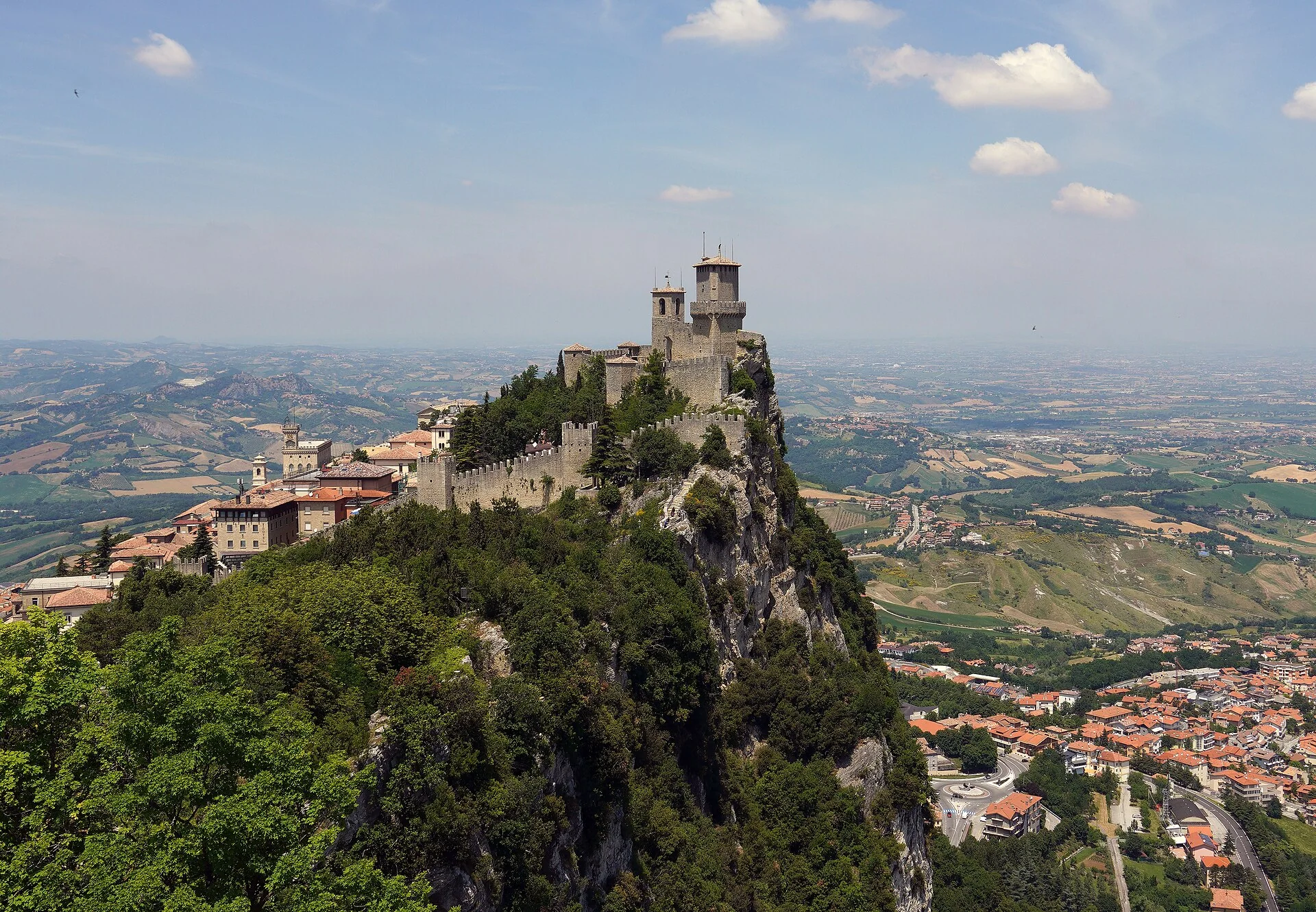
Most cultural attractions are in the capital city, which is also named San Marino. At the top of a mountain, the City of San Marino is full of old buildings, restaurants, and stores catering to tourists, as well as several small museums, and has beautiful views of the nearby towns and surrounding countryside.
The Republic of San Marino ( Italian : Repubblica di San Marino ) is the world's oldest republic and Europe's third smallest state. It is the sole survivor of the patchwork of independent city-states that used to make up the Italian peninsula before the unification of Italy. It lies 657 m (2,156 ft) above sea level with spectacular views of the surrounding countryside and Adriatic coast, only 10 km (6.2 mi) from Rimini .
Legend has it that the founder of San Marino, Saint Marinus, a stonemason, arrived from the island of Rab in Dalmatia, and climbed Mount Titano to found a small community of Christians, persecuted for their faith by the Emperor Diocletian. The country is said to have been founded in 301 AD. San Marino gave itself a constitution in 1600, the oldest written constitution still in effect, and the only republican constitution written in Latin that still has the force of law.
During the tumultuous period starting with the French Revolution, San Marino managed to preserve its independence through several strokes of luck. First, a Sammarinese politician befriended Corsican general Napoleon Bonaparte during his Italian campaign, but wisely declined his offers for more territory. Later, the small republic gave refuge to other Republicans throughout Italy, including Garibaldi, which made him disposed to respect Sammarinese wishes to stay independent. San Marino also gave honorary citizenship to Abraham Lincoln, which inspired the Great Emancipator to laud San Marino's old and stable republican institutions and point to them as an example for the US and the world to follow.
Sights and landscapes
San Marino’s main attractions are the three towers, which feature on the national flag. Only the and the are open to visitors. They are small castles at the top of Mount Titano, offering excellent views over San Marino and Italy as well as the Adriatic Sea. The third and smallest of the towers, , is inaccessible and was once used as a prison.
Cesta is the largest of the towers and inside, there is the Museum of Archaic Arms showcasing arms and armour from the Middle Ages to the 1800s. You can purchase the “Yellow Card” for €3 which lets you enter one castle, or the “Red Card” which lets you enter both and is €4.50. Between the two towers is a path which follows the city walls along the side of a cliff. The towers offer good photo opportunities.
Otherwise, walk around ! The narrow cobbled streets are full of surprises and you can go up and down the city to explore. You can climb the city walls and walk along it at places. There are virtually no cars and the streets have a very medieval feel.
San Marino has a humid subtropical climate ( Köppen climate classification : Cfa ), with some continental influences. It has warm to hot summers and cool winters, typical of inland areas of the central Italian Peninsula . Precipitation is scattered throughout the year with no real dry month. Snowfalls are common and heavy almost every winter, especially above 400–500 m (1,300–1,600 feet) of elevation.
Culture and food
San Marino's wine industry is small, but it is highly profitable and produces nearly a million bottles of wine each year. It is believed that San Marino has been producing wine for centuries. All of the wines produced in the country is stored in the Consorzio Vini Tipici di San Marino .
The most well known Sammarinese wine brand is Brugneto di San Marino , a type of red wine similar in taste to red wines from the Italian region Emilia Romagna .
The Three Towers of San Marino are located on the three peaks of Monte Titano in the capital. They are depicted on the coat of arms , which is itself contained on the flag of San Marino . The three towers are: Guaita , the oldest of the three (it was constructed in the 11th century); the 13th-century Cesta , located on the highest of Monte Titano's summits; and the 14th-century Montale , on the smallest of Monte Titano's summits, still privately owned.
The State Museum has a permanent art collection dedicated to the history and legends of the Republic. Many of these pieces originally came from public and religious buildings in the City of San Marino. Also on display are paintings and objects from the Monastery of Saint Chiara. As well as the permanent collection, the museum also hosts temporary exhibitions such as Mario Ferretti: An Artistic Restlessness of the 20th Century. The main room of the museum displays paintings by Guercino and his pupils, Cesare Gennari and Benedetto Gennari , Matteo Loves and Elisabetta Sirani . The works in an adjacent room are dedicated to the two patron saints of the Republic, Saint Marino and Saint Agata. There are also objects, such as urns and plates, that are used by San Marino institutions. Other items on display are panel paintings and sculptures from the 15th and 16th centuries.
Planning your route
Once you're inside the walled city, it's small enough to simply walk around. There are only a few streets on which cars are able to drive (and only if they are small cars). Be aware that the City of San Marino is quite vertical, making it potentially difficult for those with mobility issues to climb the switchback cobblestone streets. However, there are elevators scattered throughout town that allow easier movement up and down the city.
Travel guide text compiled and adapted from Wikivoyage article (contributors) and Wikipedia article (contributors). Sections were selected and reordered for this guide. Text is shared under CC BY-SA 4.0. Check current arrangements with your travel consultant.
Plan the full journey
Useful for this trip
This country’s visa guidance has not been fully verified against current official requirements. Confirm the application route for your passport, residence and purpose before making travel commitments.
Review details
San Marino: Official pages were retrieved, but the complete imported guidance has not been corroborated claim by claim for Kenyan ordinary passports. Still to confirm: passport validity, tourist and business eligibility, application route, any exemptions and published processing guidance. Residents using other passports require a separate nationality check.