
Nigeria
Nigeria is divided roughly in half between Muslims (who are mostly in the north and make up half the population) and Christians (who are mostly in the south). The majority of Nigerian Muslims are…
At a glance
Useful facts for planning
In this guide
Why go
Overview
Nigeria is divided roughly in half between Muslims (who are mostly in the north and make up half the population) and Christians (who are mostly in the south). The majority of Nigerian Muslims are Sunni Muslims, and the majority of Nigerian Christians are Protestants. Nigeria has the fifth largest Muslim population in the world and the sixth largest Christian population in the world.
Nigeria does have its fair share of political and social problems, but don't let that deter you; the country is endowed with a vibrant youth population who have continued to bring glory to the country in various spheres of human endeavours. The entertainment industry in Africa can not be mentioned without referencing 'Nollywood and Afrobeat'; Nigeria's movie industry and popular genre of music respectively. The country is richly blessed with a plethora of appealing tourist attractions, incredibly friendly, jovial, and sociable people, and delicious food (especially the famous West African delicacy, Jollof Rice), and travel provides you the chance to experience and explore one of the most fascinatingly diverse countries on the planet. There's lots to do and see in Nigeria.
The Nok culture of northern Nigeria flourished between 1000 BC and 500 AD producing life-sized terracotta figures which are some of the earliest known sculptures in Sub-Saharan Africa.
Tiv culture in the north central region of Nigeria dates to 6 BC. Some of the famous bronze terracotta sculpture heads from this culture have been shown around the world.
Experiences
Nollywood is a huge film industry based in Nigeria. By the early 2010s, Nigeria was producing more films than any country other than India, and the value of production was third after the U.S. and India. Nollywood films are enjoyed around the world. With diverse cultures in Nigeria, the Nigerian film industry isn't language biased: movies are shot in English, Yoruba, Igbo , Hausa , Edo, and 300 other Nigerian languages. There are cinemas in most cities and large towns where you can experience this important side of Nigerian culture.
Culture and food
There are many types of traditional cuisine to enjoy. For example: afang soup, okra soup, owo soup and starch in the Niger Delta, plantain (fried, boiled, roasted), pepper soup, amala, eba, efo, pounded yam (iyan – Yoruba for "pounded yam", pronounced " ee-yarn" ), jollof rice, ground nut soup, ogbono soup, isi ewu (goat's head stew), egusi soup, suya (kebab), moin moin, ewedu, gbegiri soup (beans soup), edikangikong, ground-rice, puff-puff, chin chin, ikokore, owerri soup (ofe owerri), which is the most expensive African soup in Nigeria. Not to forget 404 pepper soup – it will make you act like "Oliver Twist." You must realise that 404 means "dog meat." And yes, it can only be found in certain parts of the country because in the west it is seen as barbaric.
Planning your route
If you're located in a major city like Lagos or Abuja, taking ride-sharing services Bolt and Uber is usually the easiest way to get around. However, if you're travelling outside major cities you'll most likely want to hire a car and driver. In Lagos, there are lots of buses and taxis. Most smaller cities have more taxis than buses, and they are quite affordable. The okadas (motorcycle taxis) are common, but not for the faint-hearted.
For travelling from one city to another, you go to the "motor park", find the taxi that's going to your destination, and wait until it "fills up". The price is fixed, you don't have to negotiate. Some drivers may have a risky driving style however – practically this means that the only rule consistently adhered to (by cars, not necessarily motorcycles), is keeping to the right.
Sights and landscapes
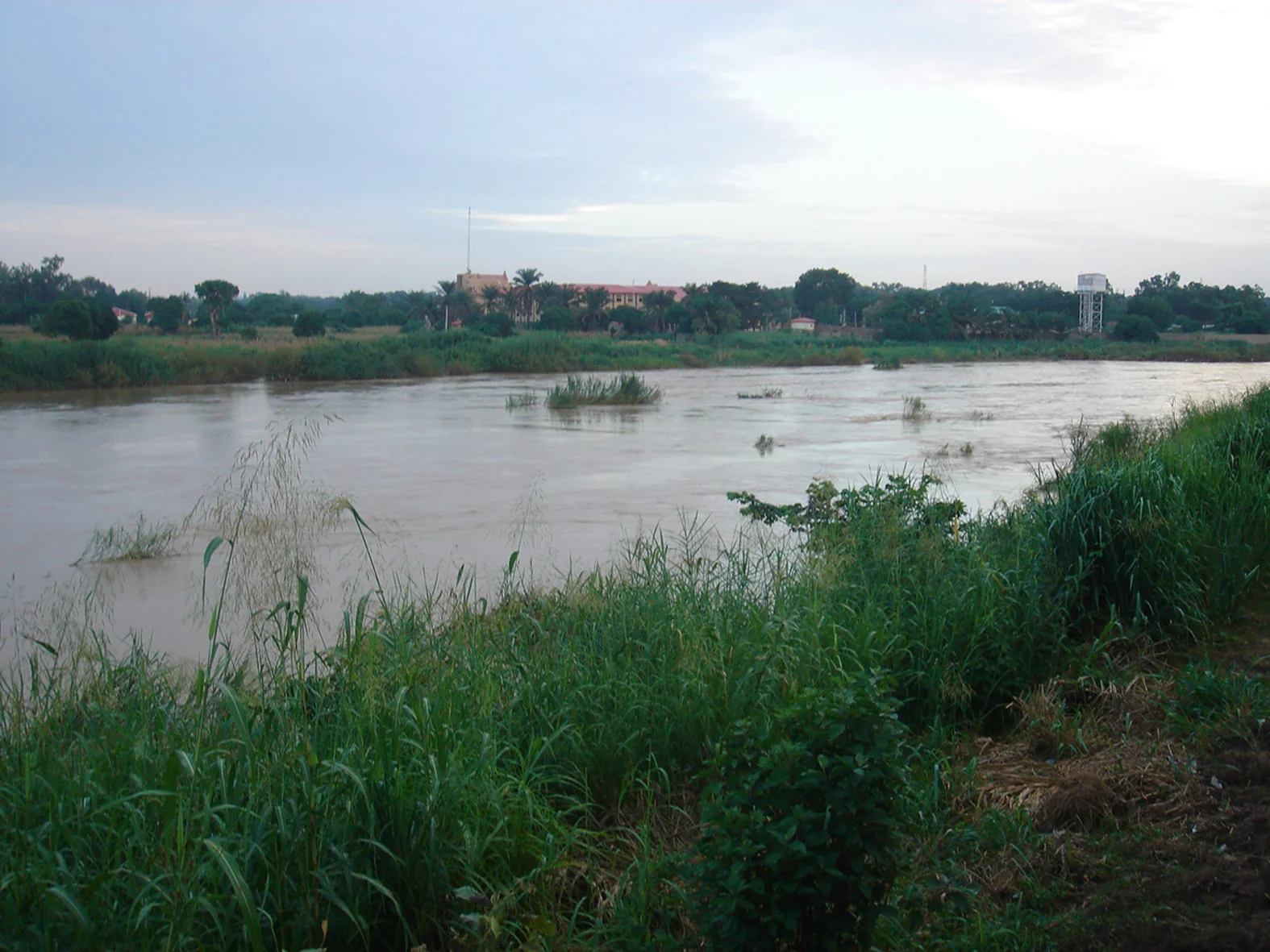
Nigeria is located in western Africa on the Gulf of Guinea and has a total area of 923,768 km 2 (356,669 mi 2 ), making it the world's 31st-largest country . Its borders span 4,047 kilometres (2,515 mi), and it shares borders with Benin (773 km or 480 mi), Niger (1,497 km or 930 mi), Chad (87 km or 54 mi), and Cameroon (including the separatist Ambazonia ) 1,690 km or 1,050 mi. Its coastline is at least 853 km (530 mi). Nigeria lies between latitudes 4° and 14°N , and longitudes 2° and 15°E . The highest point in Nigeria is Chappal Waddi at 2,419 m (7,936 ft). The main rivers are the Niger and the Benue , which converge and empty into the Niger Delta . This is one of the world's largest river deltas and the location of a large area of Central African mangroves .
Nigeria's most expansive topographical region is that of the valleys of the Niger and Benue river valleys (which merge and form a Y-shape). To the southwest of the Niger is a "rugged" highland . To the southeast of the Benue are hills and mountains, which form the Mambilla Plateau , the highest plateau in Nigeria. This plateau extends through the border with Cameroon , where the montane land is part of the Bamenda Highlands of Cameroon.
The far south is defined by its tropical rainforest climate , where annual rainfall is 1,500 to 2,000 millimetres (60 to 80 in) per year. In the southeast stands the Obudu Plateau . Coastal plains are found in both the southwest and the southeast. Mangrove swamps are found along the coast.
Travel guide text compiled and adapted from Wikivoyage article (contributors) and Wikipedia article (contributors). Sections were selected and reordered for this guide. Text is shared under CC BY-SA 4.0. Check current arrangements with your travel consultant.
Plan the full journey
Useful for this trip
This country’s visa guidance has not been fully verified against current official requirements. Confirm the application route for your passport, residence and purpose before making travel commitments.
Review details
Nigeria: Official pages were retrieved, but the complete imported guidance has not been corroborated claim by claim for Kenyan ordinary passports. Still to confirm: passport validity, tourist and business eligibility, application route, any exemptions and published processing guidance. Residents using other passports require a separate nationality check.