
Monaco
The Principality of Monaco ( French : Principauté de Monaco ) is a wealthy city-state on the Mediterranean Sea, bounded by the French Riviera . Though tiny, the country is packed with entertainment for…
At a glance
Useful facts for planning
In this guide
Why go
Overview
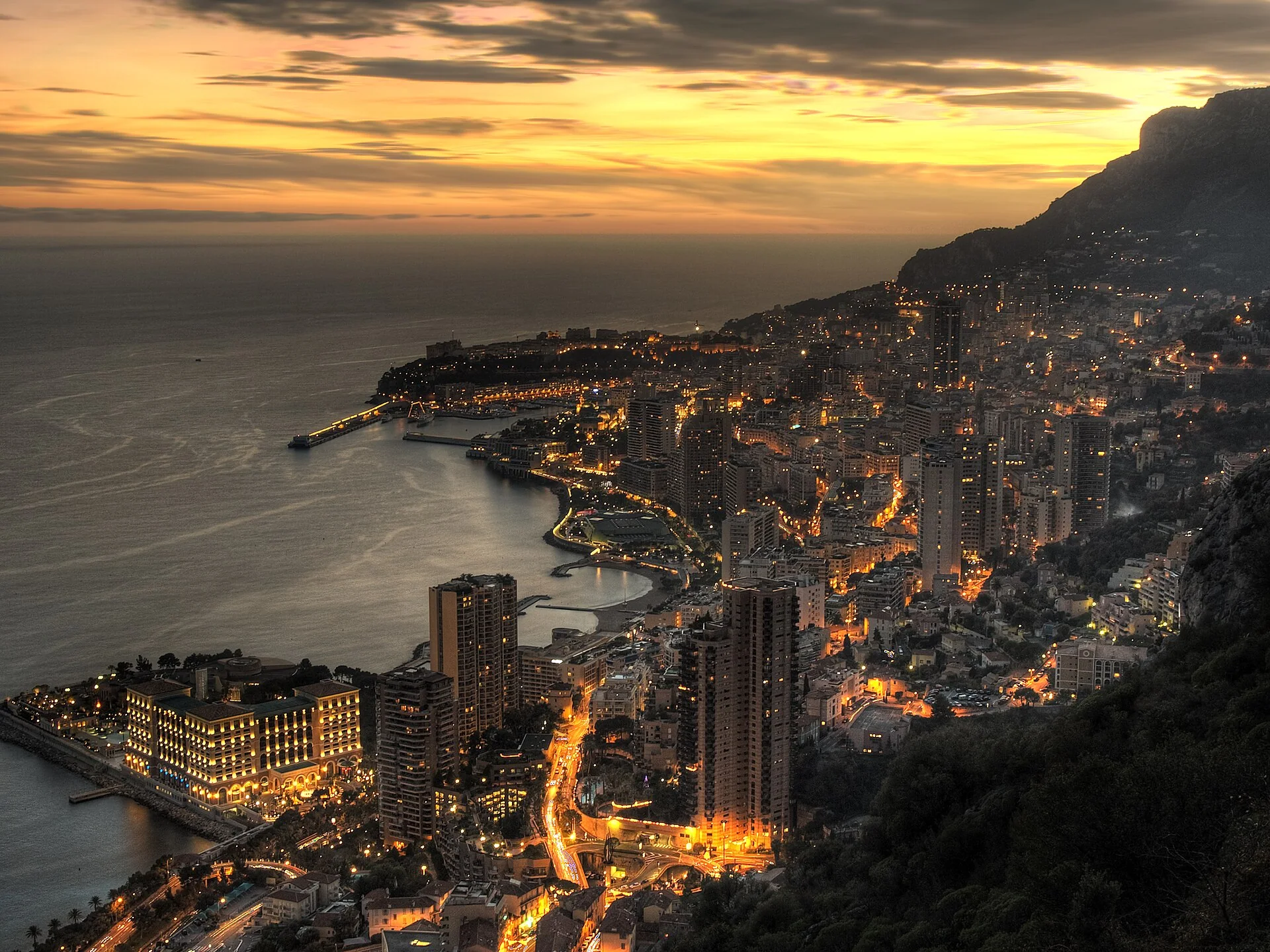
The Principality of Monaco ( French : Principauté de Monaco ) is a wealthy city-state on the Mediterranean Sea, bounded by the French Riviera . Though tiny, the country is packed with entertainment for those with money to burn: think yachts and casinos, plus the annual Formula 1 Grand Prix.
With no natural resources to exploit other than its location and climate, the principality has become a resort for tourists and a tax haven for wealthy people. Monaco is six times the size of the Vatican and the world's most densely populated country. While its borders have not moved since 1861 (when it lost over 80% of its territory to France), Monaco has still grown its territory by creating artificial land from the sea, which is how the area Fontvielle came to be. Its size is smaller than Central Park .
Sights and landscapes
The principality of Monaco offers a great balance of historical and modern attractions. There are various museums and palaces to visit as well as shopping malls and casinos. Monaco also offers relaxation spots along the harbour and even around the attractions. It is relatively easy to navigate Monte Carlo and Monaco if you take the time to learn where the various "short cuts" are. City maps are generally available at most news vendor stands and shops for a small fee. The could be a good starting point before venturing to explore the city.
Monaco is a sovereign city-state , with five quarters and ten wards, located on the French Riviera in Western Europe . It is bordered by France's Alpes-Maritimes department on three sides, with one side bordering the Mediterranean Sea . Its centre is about 16 km (9.9 mi) from Italy and only 13 km (8.1 mi) northeast of Nice .
It has an area of 2.1 km 2 (0.81 sq mi), or 208 ha (510 acres), and a population of 38,400, making Monaco the second-smallest and the most densely populated country in the world . The country has a land border of only 5.47 km (3.40 mi), a coastline of 3.83 km (2.38 mi), a maritime claim that extends 22.2 km (13.8 mi), and a width that varies between 1,700 and 349 m (5,577 and 1,145 ft).
The highest point in the country is at the access to the Patio Palace residential building on the Chemin des Révoires (ward Jardin Exotique ) from the D6007 ( Moyenne Corniche street) at 164.4 m (539 ft) above sea level . The lowest point in the country is the Mediterranean Sea.
Saint-Jean brook is the longest flowing body of water, around 0.19 km (190 m; 0.12 mi; 620 ft) in length, and Fontvieille is the largest lake, approximately 0.5 ha (1.2 acres) in area. Monaco's most populated quartier is Monte Carlo , and the most populated ward is Larvotto .
Many neighbourhoods are shared between Monaco, the immediately uphill French town of Beausoleil , the northeast parts of Cap-d'Ail , and the Figuièra area in Roquebrune-Cap-Martin , forming a transborder agglomeration with approximately 55,000 residents.
Culture and food
Food in Monaco is varied, but generally expensive, and even very basic meals often cost over €20-30. Take a look at the menu before entering even shabby restaurants or you may be in for a surprise. There are places where you can find decent value, but they often require knowing about beforehand. Restaurants where locals dine are often located a little bit away from the waterfront and often serve better food for lower prices (however, since you are in Monaco: nothing is a bargain).
There are many restaurants catering to tourists, from the Cafe de Paris across the street from the casino, to the waterfront restaurants along the Port de Fontvieille. During the winter months, you will find the restaurants to have a slightly lower price tag. Bouillabaisse is a good tip.
Monaco exhibits a wide range of architecture, but the principality's signature style, particularly in Monte Carlo, is that of the Belle Époque . It finds its most florid expression in the 1878–9 Casino and the Salle Garnier created by Charles Garnier and Jules Dutrou. Decorative elements include turrets, balconies, pinnacles, multi-coloured ceramics, and caryatids. These were blended to create a picturesque fantasy of pleasure and luxury, and an alluring expression of how Monaco sought and still seeks, to portray itself. This capriccio of French, Italian, and Spanish elements were incorporated into hacienda villas and apartments. Following major development in the 1970s, Prince Rainier III banned high-rise development in the principality. His successor, Prince Albert II , overturned this Sovereign Order. In recent years the accelerating demolition of Monaco's architectural heritage , including its single-family villas, has created dismay. The principality has no heritage protection legislation.
Planning your route
Walking is by far the best way to get around Monaco; however, there are some areas, such as the Exotic Gardens, that require a large change in elevation and therefore make for rather strenuous hikes. There are also seven public escalators and elevators (all free) that help negotiate the steep slopes of the city. If you find yourself afoot and wanting to reach the opposite bank of Port Hercule, look for the small , a pedestrian-only ferry that runs each 20 minutes or so during daylight; it costs €2.
Travel guide text compiled and adapted from Wikivoyage article (contributors) and Wikipedia article (contributors). Sections were selected and reordered for this guide. Text is shared under CC BY-SA 4.0. Check current arrangements with your travel consultant.
Plan the full journey
Useful for this trip
This country’s visa guidance has not been fully verified against current official requirements. Confirm the application route for your passport, residence and purpose before making travel commitments.
Review details
Monaco: Official pages were retrieved, but the complete imported guidance has not been corroborated claim by claim for Kenyan ordinary passports. 1 source link(s) could not be retrieved successfully; see the source log. Still to confirm: passport validity, tourist and business eligibility, application route, any exemptions and published processing guidance. Residents using other passports require a separate nationality check.