
Maldives
For many travellers, the name "Maldives" conjures up the classic picture: a tiny palm-covered island, a ribbon of almost white sand, impossibly clear turquoise water and perhaps a row of overwater villas reaching into…
At a glance
Useful facts for planning
In this guide
Why go
Overview
For many travellers, the name "Maldives" conjures up the classic picture: a tiny palm-covered island, a ribbon of almost white sand, impossibly clear turquoise water and perhaps a row of overwater villas reaching into a lagoon. That image is real — but it represents only one version of the coral islands.
Beyond the luxury resorts is a remarkably varied island country of fishing communities, compact towns, busy harbours, coral reefs, mosques, cafés, dive centres and hundreds of inhabited and uninhabited islands. Travellers can spend thousands of dollars a night on a private-island resort, stay in a locally run guesthouse for a small fraction of that, travel aboard a diving liveaboard, or combine several styles in one trip.
The sea is the country's defining feature. More than 2,000 species of fish have been recorded in Maldivian waters, alongside reef sharks, turtles, rays, dolphins and — in the right places and seasons — manta rays and whale sharks. Even travellers with no interest in scuba diving can experience much of this world simply by putting on a mask and snorkel.
The heritage of the Maldives is told in legends, in records of old copperplates, coral-carved ancient scripts and echoes of traditional culture. The story tallies in known South Asian history with mentions of the great Mauryan ruler Emperor Ashoka.
Places to explore
The Maldives consist of around 1,192 coral islands grouped into 26 natural atolls, or atholhu in Dhivehi — the source of the English word. These are not single islands, but giant ringlike coral formations hundreds of kilometres wide that have fragmented into countless islands.
An atoll is not a single island. It is an enormous ring-shaped coral formation containing lagoons, reefs, channels and often scores of individual islands. Some islands are inhabited by Maldivian communities, some are occupied entirely by resorts, some are used for agriculture or industry, and many remain uninhabited.
Atoll naming can seem bewildering, as the atolls have both lengthy traditional Dhivehi names like Maalhosmadulu Dhekunuburi , and snappy code names like Baa that refers to administrative regions and may consist of more than one geographical atoll. The shorter administrative names are widely used by resorts and the travel industry, being easier for non-Maldivians to remember and pronounce. Of the 21 administrative atoll groups, only (parts of) 10 are open to tourism, and from north to south these are:
Sights and landscapes
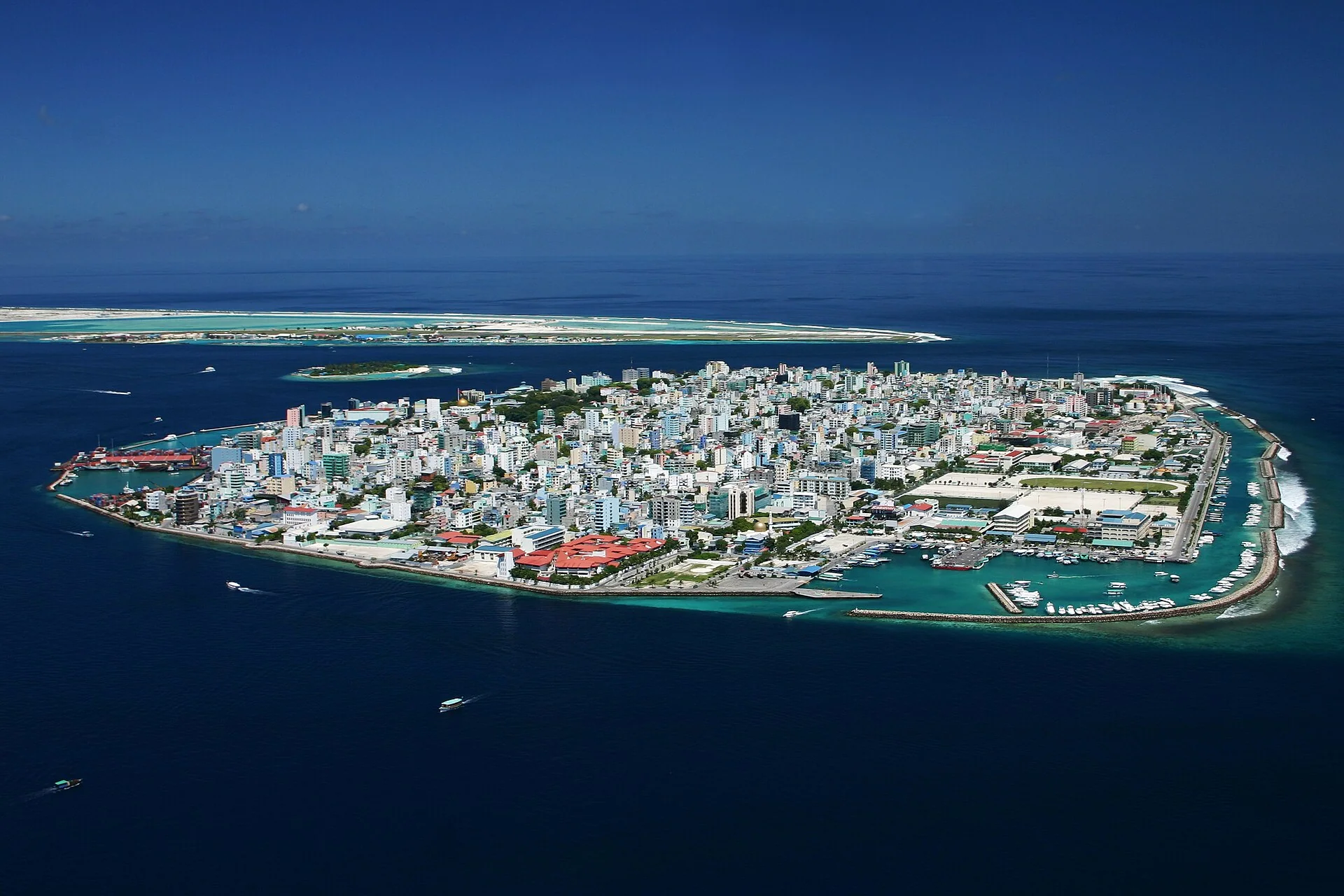
The gorgeous and ubiquitous white sand beaches are a sight by themselves, especially with the tropical island setting they are in. A flight to one of the many resort islands gives spectacular aerial views of these picture-perfect islets, defined by rims of white sand and wide strokes of cobalt blue water.
Experiences
Aside from making the water bungalow rock on your honeymoon, the primary activity on the Maldives is scuba diving . The atolls are all coral reefs hundreds of kilometres away from any major landmass, meaning that water clarity is excellent and underwater life is abundant. Manta rays, sharks, even a few wrecks, you name it, you can find it in the Maldives.
While diving is very good by world standards even in the immediate vicinity of Malé, visibility and the chance of encountering large pelagic fish increases as you head to the outer atolls. Many divers opt for live-aboards, which can work out much cheaper than paying high resort fees. Currents vary considerably, with generally little inside the atolls but some powerful streams to be found on the sides facing the open sea. Water in the Maldives is warm throughout the year and a 3 mm shorty or Lycra dive skin is sufficient. Diving is possible throughout the year, but rain, wind and waves are most common during the season of the southwest monsoon (June-November). The best time for scuba diving is from January to April when the sea is calm, the sun is shining and the visibility can reach 30 m. There are decompression chambers on Bandos in Kaafu (15 min from Malé), Kuredu in Lhaviyani Atoll and at Kuramathi on Alifu .
Culture and food
All the resorts are self-contained so they have at least one restaurant, which generally serves the type of cuisine expected by their guests (i.e. modern European or generic Asian). Breakfast is almost always included, and most resorts offer the option of half-board , which means you get a dinner buffet, and full board , which means you get a lunch and dinner buffet. These can limit the damage compared to ordering à la carte, but your options are typically very limited and drinks are often not covered, not necessarily even water. If you're planning on drinking a lot, it may be worthwhile to go all inclusive , but even this typically restricts you to house drinks.
Planning your route
There are four main ways of getting around in the Maldives: domestic flight , boat , seaplane and private yacht (liveaboard). The boats are the Maldivian equivalent of a car, while seaplanes and private yachts (liveaboards) are mainly reserved for tourists.
Seaplanes prefer not to operate at night, so if you arrive at the airport after dark and are going to a distant resort, you may have to spend the night in Malé , Hulhumalé or at the airport hotel in Hulhulé . Private transfers, though expensive can be opted for resort transfers, instead of spending the whole night at Malé City. Private transfers could cost US$500-800. On the way back, there may also be a significant gap between the time your transfer arrives and your flight departure. Check with your resort or travel agent.
Travel guide text compiled and adapted from Wikivoyage article (contributors). Sections were selected and reordered for this guide. Text is shared under CC BY-SA 4.0. Check current arrangements with your travel consultant.
Plan the full journey
Useful for this trip
Reviewed for Kenyan ordinary passport holders travelling for the stated purpose. Recheck the official requirements before applying.
Review details
Official-source desk review on 13 October 2026: Kenyan ordinary passports; tourism, approved business and qualifying meeting visits. Tourist passport/declaration/entry conditions, distinct business passport and prior-approval rules, and Meeting Visa restrictions were checked. No processing deadline, employment permission or guaranteed entry is promised. Other nationalities and long-term categories need separate review.