
Germany
Germany ( German : Deutschland ) is the largest country in Central Europe . It is known for its rich cultural heritage, innovative inventions, its old-world charm and Gemütlichkeit (cosiness). Discard any perceptions of…
At a glance
Useful facts for planning
In this guide
Why go
Overview
Germany ( German : Deutschland ) is the largest country in Central Europe . It is known for its rich cultural heritage, innovative inventions, its old-world charm and Gemütlichkeit (cosiness). Discard any perceptions of Germany as being homogeneous; a country of surprising regional diversity awaits your presence. Many tourists visit Germany to experience European history and the diverse German landscape. German culture, outdoor activities, German holidays and festivities, the countryside and rural areas, and the German cities are identified as being big draws for visitors.
In the first century AD, after a series of military campaigns, the Romans conquered what is now most of western and southern Germany from the Germanic and Celtic tribes living there. The limits of the Roman empire were marked by the "Limes". The section separating the empire from the Germanic tribes ( Limes Germanicus ) was 568 km long, stretching from the mouth of the Rhine to the Danube near Regensburg . You can still see and walk along sections of the raised bank. In Roman times the Limes were not a rigid border: trade and occasional Roman military expeditions influenced most of what is now Germany until at least the fourth century AD.
Several cities that are still important in Germany were founded by the Romans as military bases and later, settlements, including Mainz , Wiesbaden , Cologne and Bonn . Baden-Baden 's springs were also much appreciated by the Romans: the remains of their baths can be visited under the aptly-named Römerplatz (Roman Square). The most impressive Roman remains in Germany can be found in Trier , the oldest German city. These include the Porta Nigra, the largest Roman city gate north of the Alps, and the Trier Amphitheatre.
Places to explore
Officially known as the Federal Republic of Germany ( Bundesrepublik Deutschland ), Germany has 16 states (called Bundesländer – shortened to Länder ) that sometimes correspond to historic regions and sometimes group very different peoples into the same state. Three of these Bundesländer are city-states: Berlin , Bremen and Hamburg . For a long time, the cultural division between north and south was the most notable but, because of the legacy of the Cold War, nowadays the division between east and west is more noticeable.
Germany has numerous cities of interest to visitors; here are just nine of the most famous travel destinations. They are mostly the larger cities of Germany. Some, such as Berlin and Hamburg, stand like urban islands in more rural landscapes, others, like Düsseldorf and Frankfurt, are part of metropolitan areas together with other cities.
Sights and landscapes
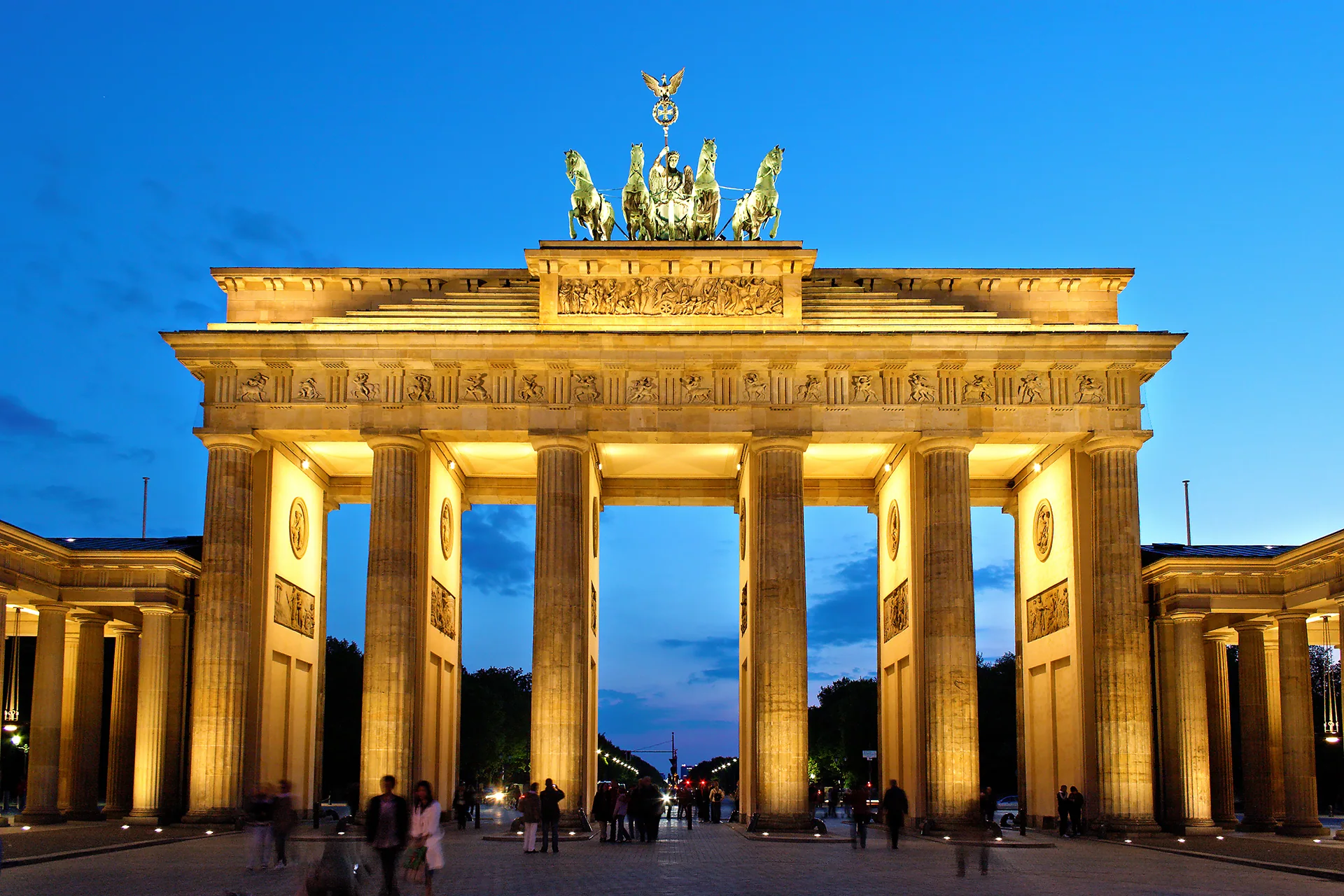
A completely different experience can be found in Berlin , a city unlikely to be found anywhere else on the planet. While architecturally an odd mismatch of sterilised apartment blocks, post-modernist glass and steel structures, and historic buildings, it has a laid-back atmosphere and a culture of internationalism. Its turbulent history gave rise to an enormous wealth of historical attractions, among them the Berlin Wall, Brandenburger Tor, Bundestag, Checkpoint Charlie, Fernsehturm, Holocaust Memorial, Rotes Rathaus and Cathedral. But do not miss out the Prenzlauer Berg neighbourhood if you want to feel like a true Berliner. Kreuzberg (once famous for punks, now largely gentrified) and the delightfully named Wedding aren't far behind either.
Experiences
18 clubs play in Bundesliga the top tier, where famous names include Bayern München , Borussia Dortmund and Hamburger SV. 18 play in 2. Bundesliga and 20 in 3. Liga.
Other popular sports include (Olympic) handball (especially popular in the north), ice-hockey ("Eishockey"), volleyball and basketball. Motor sports are a popular visitor attraction, with many famous Formula one courses like Hockenheim and Nürburgring ("Green Hell").
Germany – particularly the North – is also one of the best countries when it comes to Handball . Teams like Flensburg, Kiel and others draw sellout crowds to their halls week in week out and produce some of the best Handball in the world.
Culture and food
German food has traditionally been simple and hearty, and a typical dish will consist of meat with some form of potatoes and gravy, accompanied by vegetables or salad. That said, with an increasingly cosmopolitan Germany, as well as imports and technological advancements that have made it possible to procure new ingredients that were historically unavailable locally, a new style known as modern German cuisine has developed, particularly in fine dining restaurants. This new style has absorbed influences from other European countries such as Italy and France , making it lighter than traditional German food. Modern German cuisine has also absorbed considerable Turkish influences, due to the large number of Turkish immigrants in Germany. Dishes show a great local diversity, interesting to discover. Most German Gaststätte and restaurants tend to be children and dog friendly, although both are expected to behave and not be too boisterous.
Planning your route
On the whole transportation is efficient and fast, though last minute tickets can be a bit on the expensive side. All modes of transportation are up to a high modern standard, including a dense network of airports, high speed rail services connecting most major cities and regional trains, one of the densest highway networks on earth (with stretches where the speed limit is shrug emoji), and intercity bus services.
Given Germany's well-developed road and rail network, there are few routes where it makes sense to fly . High-speed rail services offer better overall journey times on even the longest routes, and flights are almost never cheaper than other options. The domestic options are usually "hub-feeder" services to either Frankfurt Airport or Munich Airport , but that is hardly ever faster than a train. There are few point-to-point domestic flights outside those hubs.
Travel guide text compiled and adapted from Wikivoyage article (contributors). Sections were selected and reordered for this guide. Text is shared under CC BY-SA 4.0. Check current arrangements with your travel consultant.
Plan the full journey
Useful for this trip
Reviewed for Kenyan ordinary passport holders travelling for the stated purpose. Recheck the official requirements before applying.
Review details
Scoped official-source desk review on 13 October 2026: Kenyan ordinary-passport tourism and short business-visit orientation, Kenya-resident application route, passport conditions and published processing guidance. The embassy tourism and business checklists support the summaries; German official general passport guidance supports the ten-year condition. Individual eligibility, work permission, transit, special-passport and EU-family exemptions are outside this review. No guarantee of visa issuance or entry.