
Equatorial Guinea
Equatorial Guinea ( Spanish : República de Guinea Ecuatorial ) is a small country in Central Africa that's divided into three parts: the mainland, Bioko Island, where the former capital is located, and Annobón…
At a glance
Useful facts for planning
In this guide
Why go
Overview
Equatorial Guinea ( Spanish : República de Guinea Ecuatorial ) is a small country in Central Africa that's divided into three parts: the mainland, Bioko Island, where the former capital is located, and Annobón Island. The mainland is wedged between Cameroon and Gabon . It is one of the largest oil producers in Africa, along with Angola and Nigeria .
In the Río Muni region, there is believed to have been a widespread pygmy population, of whom only isolated pockets remain in the north. Bantu migrations between the 17th and 19th centuries brought the coastal tribes and later the Fang.
The Portuguese explorer Fernão do Pó, seeking a path to India , is credited as being the first European to discover the island of Bioko in 1472. He called it Formosa ("Beautiful"), but it quickly took on the name of its European discoverer. The islands of Fernando Pó and Annobón were colonized by Portugal in 1474.
In 1778, the island, adjacent islets, and commercial rights to the mainland between the Niger River and Ogoue Rivers were ceded to the Spanish Empire in exchange for territory in the American continent. From 1827 to 1843, the United Kingdom established a base on the island to combat the slave trade which was then moved to Sierra Leone upon agreement with Spain in 1843. In 1844, on restoration of Spanish sovereignty, it became known as the Territorios Españoles del Golfo de Guinea Ecuatorial . The mainland portion, Rio Muni, became a protectorate in 1885 and a colony in 1900. Between 1926 and 1959 all three regions were united as the colony of Spanish Guinea. Spanish settlers arrived and created plantations in the colony.
Culture and food
There are several good places to eat, particularly in Malabo. The coffee shop at Hotel Sofitel (across from the Cathedral along the north coast) offers French cuisine. Hotel Bahia's main restaurant is also a favorite destination for locals and expats. For pizza and pasta, the Pizza Place is the best place in the city. For Asian cuisine, Restaurante Bantu offers Chinese cuisine. For Moroccan and European food, try La Luna. Try Equatorial Guinean cuisine such as smoked beef with a black pepper. There is also a roast duck with cheese and onion leaf.
Tourist attractions are the colonial quarter in Malabo, the southern part of Bioko where hikers can visit the Iladyi cascades and remote beaches with nesting turtles, Bata with its shoreline Paseo Maritimo and the tower of liberty, Mongomo with its basilica (the second largest Catholic church in Africa) and the planned capital Ciudad de la Paz .
The principal means of communication within Equatorial Guinea are three state-operated FM radio stations: the BBC World Service , Radio France Internationale and Gabon-based Africa No 1 broadcast on FM in Malabo. There is also an independent radio option called Radio Macuto; it is a web-based radio and news source known for publishing news that calls out Obiang's regime. There are also five shortwave radio stations. Televisión de Guinea Ecuatorial , the television network, is state-operated. The international TV programme RTVGE is available via satellites in Africa, Europe, and the Americas and worldwide via the Internet. There are two newspapers and two magazines.
Sights and landscapes
Equatorial Guinea is on the west coast of Central Africa . The country consists of a mainland territory, Río Muni , which is bordered by Cameroon to the north and Gabon to the east and south, and five small islands, Bioko , Corisco , Annobón , Elobey Chico (Small Elobey), and Elobey Grande (Great Elobey). Bioko, lies about 40 kilometers (25 mi) off the coast of Cameroon. Annobón Island is about 350 kilometers (220 mi) west-south-west of Cape Lopez in Gabon. Corisco and the two Elobey islands are in Corisco Bay, on the border of Río Muni and Gabon.
Equatorial Guinea lies between latitudes 4°N and 2°S , and longitudes 5° and 12°E . Despite its name, no part of the country's territory lies on the equator—it is in the northern hemisphere, except for the insular Annobón Province , which is about 155 km (96 mi) south of the equator.
Equatorial Guinea has a tropical climate with distinct wet and dry seasons. From June to August, Río Muni is dry and Bioko wet; from December to February, the reverse occurs. In between it, there is a gradual transition. Rain or mist occurs daily on Annobón, where a cloudless day has never been registered. The temperature at Malabo, Bioko, ranges from 16 °C (61 °F) to 33 °C (91 °F), though on the southern Moka Plateau, normal high temperatures are only 21 °C (70 °F). In Río Muni, the average temperature is about 27 °C (81 °F). Annual rainfall varies from 1,930 mm (76 in) at Malabo to 10,920 mm (430 in) at Ureka , Bioko, but Río Muni is somewhat drier.
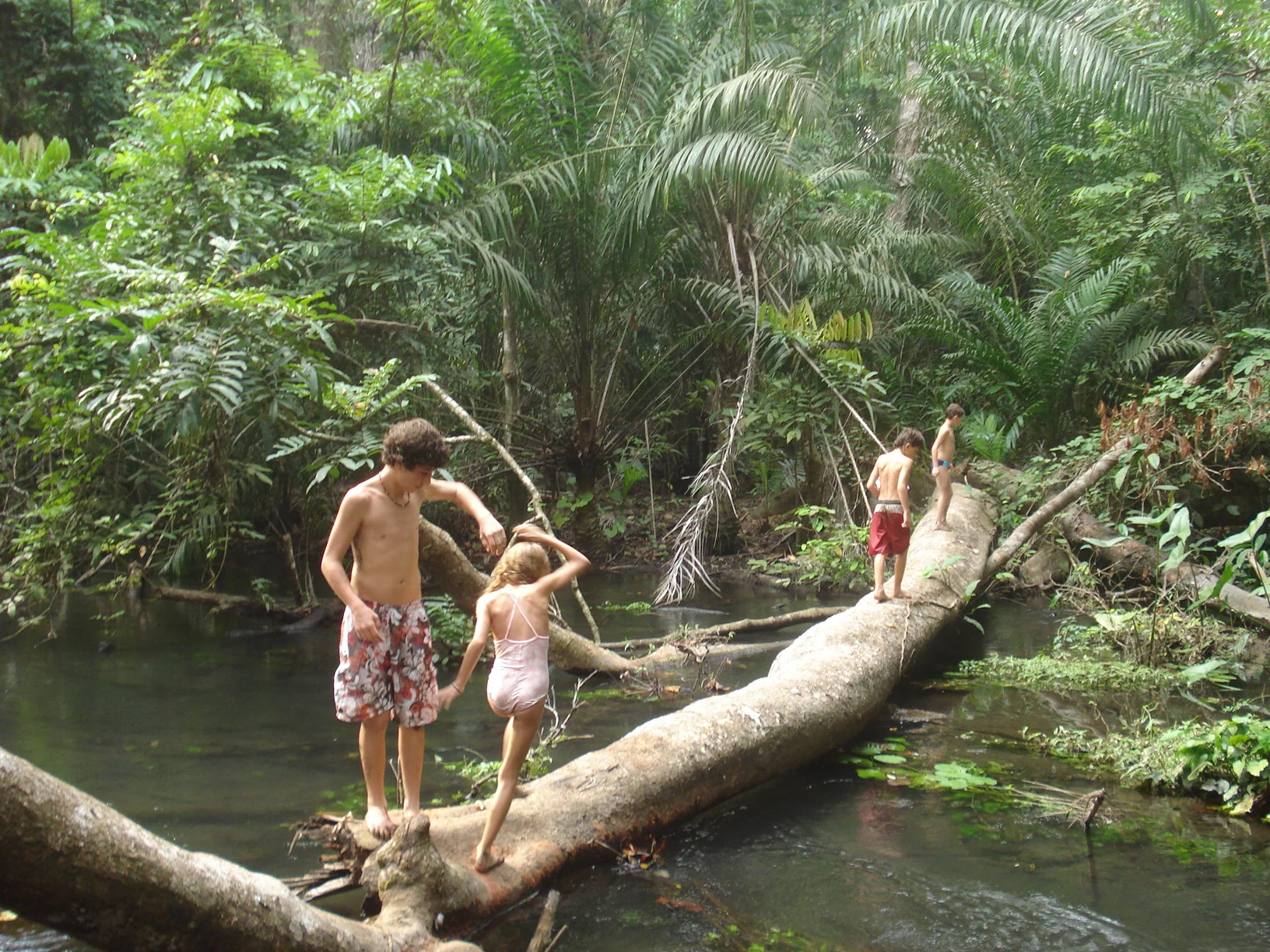
Equatorial Guinea spans several ecoregions . Río Muni region lies within the Atlantic Equatorial coastal forests ecoregion except for patches of Central African mangroves on the coast, especially in the Muni River estuary. The Cross-Sanaga-Bioko coastal forests ecoregion covers most of Bioko and the adjacent portions of Cameroon and Nigeria on the African mainland, and the Mount Cameroon and Bioko montane forests ecoregion covers the highlands of Bioko and nearby Mount Cameroon . The São Tomé, Príncipe, and Annobón moist lowland forests ecoregion covers all of Annobón, as well as São Tomé and Príncipe.
Equatorial Guinea is home to gorillas , chimpanzees , various monkeys, leopards , buffalo , antelope , elephants , hippopotamuses , crocodiles , and various snakes , including pythons .
Travel guide text compiled and adapted from Wikivoyage article (contributors) and Wikipedia article (contributors). Sections were selected and reordered for this guide. Text is shared under CC BY-SA 4.0. Check current arrangements with your travel consultant.
Plan the full journey
Useful for this trip
This country’s visa guidance has not been fully verified against current official requirements. Confirm the application route for your passport, residence and purpose before making travel commitments.
Review details
Equatorial Guinea: The supplied sources could not provide sufficient readable official guidance during this assessment. Still to confirm: passport validity, tourist and business eligibility, application route, any exemptions and published processing guidance. Residents using other passports require a separate nationality check.