
Djibouti
Djibouti is in the Horn Peninsula on the Gulf of Aden. The country can be divided into three regions; the coastal plain and volcanic plateaus in the central and southern parts of the country…
At a glance
Useful facts for planning
In this guide
Why go
Overview
Djibouti is in the Horn Peninsula on the Gulf of Aden. The country can be divided into three regions; the coastal plain and volcanic plateaus in the central and southern parts of the country and the mountain ranges in the north. Much of the country is wasteland with virtually no arable land.
Djibouti's climate is very hot, humid and arid, especially in the summer. The summer heat is moderated, however, by a sustained breeze in the coastal city of Djibouti. From October to April, the temperature is cooler, with occasional rain. Cyclones from the Indian Ocean create heavy rains and flash flooding.
Djibouti , officially the Republic of Djibouti , is a country in the Horn of Africa , bordered by Somalia to the south, Ethiopia to the southwest, Eritrea in the north, and the Red Sea and the Gulf of Aden to the east. The country has an area of 23,200 km 2 (8,958 sq mi).
Culture and food
The city of Djibouti has many places to eat, including tourist traps. Western food is often expensive cuisine, with local cuisine being much cheaper. For example, the Ethiopian Community Center offers a wide variety of local, tasty and reasonably priced dishes. Average price per meal outside tourist areas is US$4 including drink.
Djiboutian attire reflects the region's hot and arid climate. When not dressed in Western clothing such as jeans and T-shirts, men typically wear the macawiis , which is a traditional sarong -like garment worn around the waist. Many nomadic people wear a loosely wrapped white cotton robe called a tobe that goes down to about the knee, with the end thrown over the shoulder.
Women typically wear the dirac , which is a long, light, diaphanous voile dress made of cotton or polyester that is worn over a full-length half-slip and a bra. Married women tend to sport head-scarves referred to as shash and often cover their upper body with a shawl known as garbasaar . Unmarried or young women do not always cover their heads. Traditional Arabian garb such as the male jellabiya ( jellabiyaad in Somali) and the female jilbāb is also commonly worn. For some occasions such as festivals, women may adorn themselves with specialized jewelry and head-dresses similar to those worn by the Berber tribes of the Maghreb .
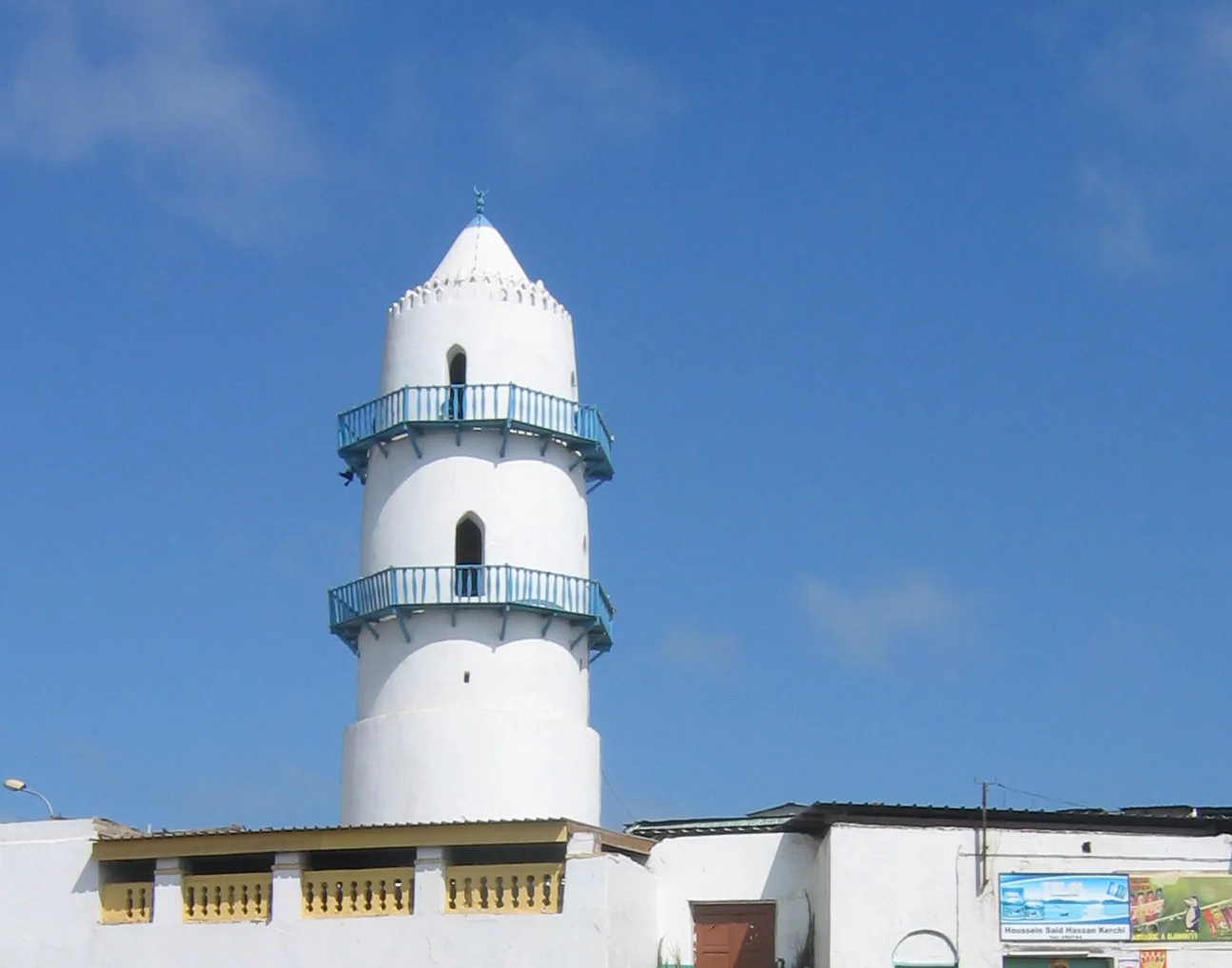
A lot of Djibouti's original art is passed on and preserved orally, mainly through song. Many examples of Islamic, Ottoman, and French influences can also be noted in the local buildings, which contain plasterwork, carefully constructed motifs , and calligraphy .
Planning your route
You should avoid driving after dark outside the city of Djibouti. Vehicles do not always have working headlights and there may be livestock on the roads. Extra care must be taken in the occasionally chaotic traffic.
Sights and landscapes
Djibouti is in the Horn of Africa , on the Gulf of Aden and the Bab-el-Mandeb , at the southern entrance to the Red Sea . It lies between latitudes 11° and 14°N and longitudes 41° and 44°E, at the northernmost point of the Great Rift Valley . It is in Djibouti that the rift between the African Plate and the Somali Plate meets the Arabian Plate , forming a geologic tripoint. The tectonic interaction at this tripoint has created the lowest elevation of any place in Africa at Lake Assal , and the second-lowest depression on dry land anywhere on earth (surpassed only by the depression along the border of Jordan and Israel).
The country's coastline stretches 314 kilometres (195 miles), with terrain consisting mainly of plateau, plains and highlands. Djibouti has a total area of 23,200 square kilometres (8,958 sq mi). Its borders extend 575 km (357 mi), 125 km (78 mi) of which are shared with Eritrea , 390 km (242 mi) with Ethiopia , and 60 km (37 mi) with Somaliland . Djibouti is the southernmost country on the Arabian Plate .
Djibouti has eight mountain ranges with peaks of over 1,000 metres (3,300 feet). The Mousa Ali range is considered the country's highest mountain range, with the tallest peak on the border with Ethiopia and Eritrea. It has an elevation of 2,028 metres (6,654 feet). The Grand Bara desert covers parts of southern Djibouti in the Arta, Ali Sabieh and Dikhil regions. The majority of it sits at a relatively low elevation, below 1,700 feet (520 metres).
Extreme geographic points include: to the north, Ras Doumera and the point at which the border with Eritrea enters the Red Sea in the Obock Region; to the east, a section of the Red Sea coast north of Ras Bir; to the south, a location on the border with Ethiopia west of the town of As Ela ; and to the west, a location on the frontier with Ethiopia immediately east of the Ethiopian town of Afambo .
Background
The Bab-el-Mandeb region has often been considered a primary crossing point for early hominins following a southern coastal route from East Africa to South and Southeast Asia .
The Djibouti area has been inhabited since the Neolithic . According to linguists, the first Afroasiatic -speaking populations arrived in the region during this period from the family's proposed urheimat ("original homeland") in the Nile Valley , or the Near East . Other scholars propose that the Afroasiatic family developed in situ in the Horn, with its speakers subsequently dispersing from there.
Travel guide text compiled and adapted from Wikivoyage article (contributors) and Wikipedia article (contributors). Sections were selected and reordered for this guide. Text is shared under CC BY-SA 4.0. Check current arrangements with your travel consultant.
Plan the full journey
Useful for this trip
This country’s visa guidance has not been fully verified against current official requirements. Confirm the application route for your passport, residence and purpose before making travel commitments.
Review details
Djibouti: The supplied sources could not provide sufficient readable official guidance during this assessment. Still to confirm: passport validity, tourist and business eligibility, application route, any exemptions and published processing guidance. Residents using other passports require a separate nationality check.