
Cuba
Cuban cuisine has a partly deserved reputation for being bland , particularly compared with some neighbors like Jamaica. The national dish in Cuba is rice and beans ( moros y cristianos ), and the…
At a glance
Useful facts for planning
In this guide
Why go
Culture and food
Cuban cuisine has a partly deserved reputation for being bland , particularly compared with some neighbors like Jamaica. The national dish in Cuba is rice and beans ( moros y cristianos ), and the local spice repertoire rarely extends beyond salt and garlic. While the state-run restaurants many tourists ended up eating at had little incentive to improve flavor, the dining scene has improved considerably and the best food will generally be found in your casa particular or in privately owned and operated restaurants called paladares .
Black beans are a main staple in Cuban households. Cubans eat mainly pork and chicken for meat. Beef and lobster are controlled by the state, and therefore illegal to sell outside of state owned hotels and restaurants, however special lobster lunch/supper offers are plentiful for tourists. You may see turtle on menus in paladares , but they are endangered and eating them is illegal. That an item is listed on a menu does not, however, mean it is available.
Paladares , locally owned restaurants in private homes, are plentiful, even in the smaller towns. Seating is often limited, so you may need to arrive when they open, usually around 17:00-18:00. If you are staying in a casa particular ask your host for recommendations, as the quality of the food can vary substantially between paladares. Only eat in ones that have a printed menu with prices, otherwise you are very likely to pay two to three times as much as you should. Several have taken to printing two different menus, one with local prices and one with foreigner prices. Eating in paladares is legal, but if you are taken there by a Cuban, you may be charged extra in order to cover commission of the person who brought you. A supper will cost around ~US$7-10 per person.
Planning your route
For reliable offline maps, GPS navigation , comprehensive trails and map information, consult OpenStreetMap , which is also used by this travel guide, and by many mobile Apps like OsmAnd (advanced with many add-ons), Mapy.cz , Organic Maps (fast and easy to use by the original developers who left Maps.me after new ownership degraded the app), or use OpenAndroMaps for South and Middle America with apps like Oruxmaps or Locus.
You can help improve the map by contributing places and other data to OpenStreetMap by editing the map or taking street-level photos with Mapillary and uploading when you have good connection or leave Cuba. Several years back the OpenStreetMap community used Mapillary to effectively capture imagery of La Habana useful for mapping.
Sights and landscapes
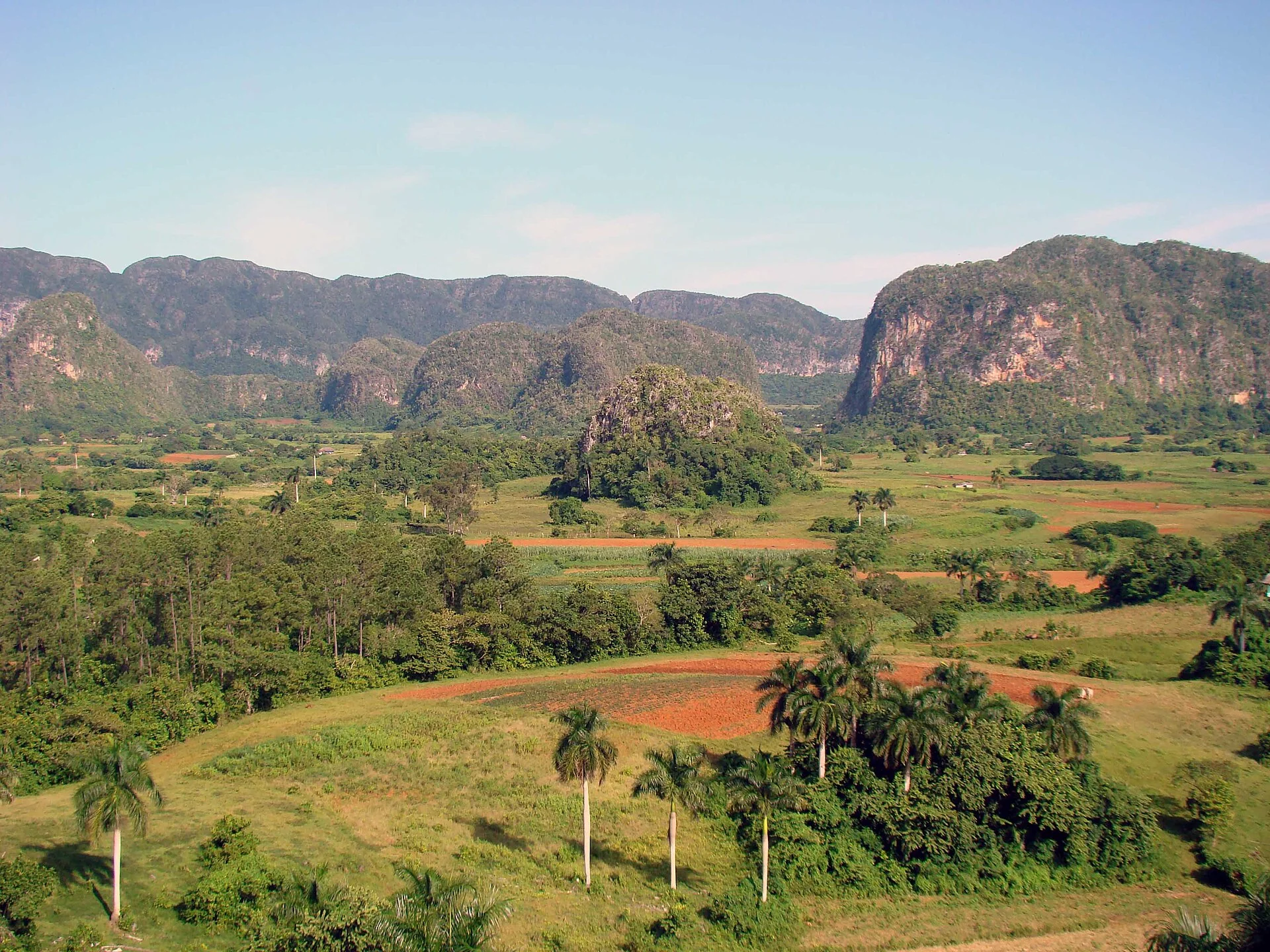
Cuba is an archipelago of 4,195 islands, cays and islets located in the northern Caribbean Sea at the convergence of the Gulf of Mexico and the Atlantic Ocean. It lies between latitudes 19° and 24°N , and longitudes 74° and 85°W . Key West, Florida , is about 150 km (93 miles) across the Straits of Florida to the north and northwest, and The Bahamas ( Cay Lobos ) 22.5 km (14 mi) to the north. Mexico lies 210 km (130.5 mi) west across the Yucatán Channel (to the closest tip of Cabo Catoche ). Haiti is 78 km (48.5 mi) east and Jamaica 148 km (92 mi) south.
Cuba is the principal island, surrounded by four smaller groups of islands: the Colorados Archipelago on the northwestern coast, the Sabana-Camagüey Archipelago on the north-central Atlantic coast, the Jardines de la Reina on the south-central coast and the Canarreos Archipelago on the southwestern coast. The main island, named Cuba, is 1,250 km (780 mi) long, constituting most of the nation's land area (104,338 km 2 or 40,285 sq mi) and is the largest island in the Caribbean and 17th-largest island in the world. The main island consists mostly of flat to rolling plains apart from the Sierra Maestra mountains in the southeast, whose highest point is Pico Turquino (1,974 m or 6,476 ft). The second-largest island is Isla de la Juventud in the Canarreos Archipelago, with an area of 2,204 km 2 (851 sq mi). Cuba has an official area of 109,884 km 2 (42,426 sq mi). Its area is 110,860 km 2 (42,803 sq mi) according to the CIA .
With the entire island south of the Tropic of Cancer , the local climate is tropical, moderated by northeasterly trade winds that blow year-round. The temperature is also shaped by the Caribbean Current which brings in warm water from the Equator. This makes the climate of Cuba warmer than that of Hong Kong, which is at around the same latitude as Cuba but has a subtropical rather than a tropical climate. In general (with local variations), there is a drier season from November to April, and a rainier season from May to October. The average temperature is 21 °C (70 °F) in January and 27 °C (81 °F) in July. The warm temperatures of the Caribbean Sea and the fact that Cuba sits across the entrance to the Gulf of Mexico combine to make the country prone to frequent hurricanes . These are most common in September and October.
The native bee hummingbird or zunzuncito is the world's smallest known bird, with a length of 55 mm ( 2 + 1 ⁄ 8 in). The Cuban trogon or tocororo is the national bird of Cuba and an endemic species. Other endemic species are the Cuban crocodile , Cuban hutia , Cuban solenodon , Cuban gar , Cuban boa , and Polymita picta . Hedychium coronarium , named mariposa in Cuba, is the national flower.
Travel guide text compiled and adapted from Wikivoyage article (contributors) and Wikipedia article (contributors). Sections were selected and reordered for this guide. Text is shared under CC BY-SA 4.0. Check current arrangements with your travel consultant.
Plan the full journey
Useful for this trip
This country’s visa guidance has not been fully verified against current official requirements. Confirm the application route for your passport, residence and purpose before making travel commitments.
Review details
Cuba: The supplied sources could not provide sufficient readable official guidance during this assessment. 2 source link(s) could not be retrieved successfully; see the source log. Still to confirm: passport validity, tourist and business eligibility, application route, any exemptions and published processing guidance. Residents using other passports require a separate nationality check.