
Belarus
Belarus ( Belarusian and Russian : Белару́сь) is a former Soviet state whose history begins in the 10th century CE. While not on most tourists' radar, Belarus preserves beautiful castles, pristine nature, and Soviet…
At a glance
Useful facts for planning
In this guide
Why go
Overview
Belarus ( Belarusian and Russian : Белару́сь) is a former Soviet state whose history begins in the 10th century CE. While not on most tourists' radar, Belarus preserves beautiful castles, pristine nature, and Soviet heritage. It maintains close ties and an open border with its neighbor Russia .
Commonly referred to as "Europe's last dictatorship", Belarus is a strict authoritarian country. As a tourist you should remain cautious in Belarus due to arbitrary law enforcement, extensive surveillance, political repression, and the risk of sudden border or travel restrictions or avoid visiting the country altogether.
The territory of modern-day Belarus was once inhabited by Baltic tribes most of whom succumbed to Slavic invasions overtime. By the 9th century, the lands of present-day Belarus were inhabited by East Slavic tribes, such as the Krivichs, Dregovichs, and Radimichs as well as Baltic peoples in the northwest such as Yotvingians and Lithuanians. The East Slavic tribes gradually became part of the Kievan Rus’, a powerful medieval state with its center in Kyiv.
In the 13th century, as Kievan Rus’ weakened due to Mongol invasions, Belarusian lands were gradually absorbed into the expanding Grand Duchy of Lithuania. Under Lithuanian rule, however, the conquered Belarusian regions retained a large degree of autonomy. Throughout the 13th and 14th centuries the Lithuanian state grew, encompassing the city of Smolensk (now in Russia) and the lands eastward to the neighbourhood of Moscow and southward to Kyiv and the shores of the Black Sea. During this epoch of Lithuanian domination, the Belarusian language and nationality began to take shape. In 1569 the Union of Lublin formally merged the Grand Duchy of Lithuania with the Kingdom of Poland, creating the Polish-Lithuanian Commonwealth. Belarusian lands were now under joint Polish-Lithuanian rule, with Polish influence increasing over time. Throughout the 17th and 18th centuries, ethnically Belarusian lands suffered greatly from wars and invasions, including conflicts with Muscovy (Russia) and Sweden.
Places to explore
The oblasts of Belarus provide no real guidance for a tourist. These divisions are of purely administrative nature, were created less than a century ago and have very little to do with historical, cultural or ethnographic matters.
Sights and landscapes
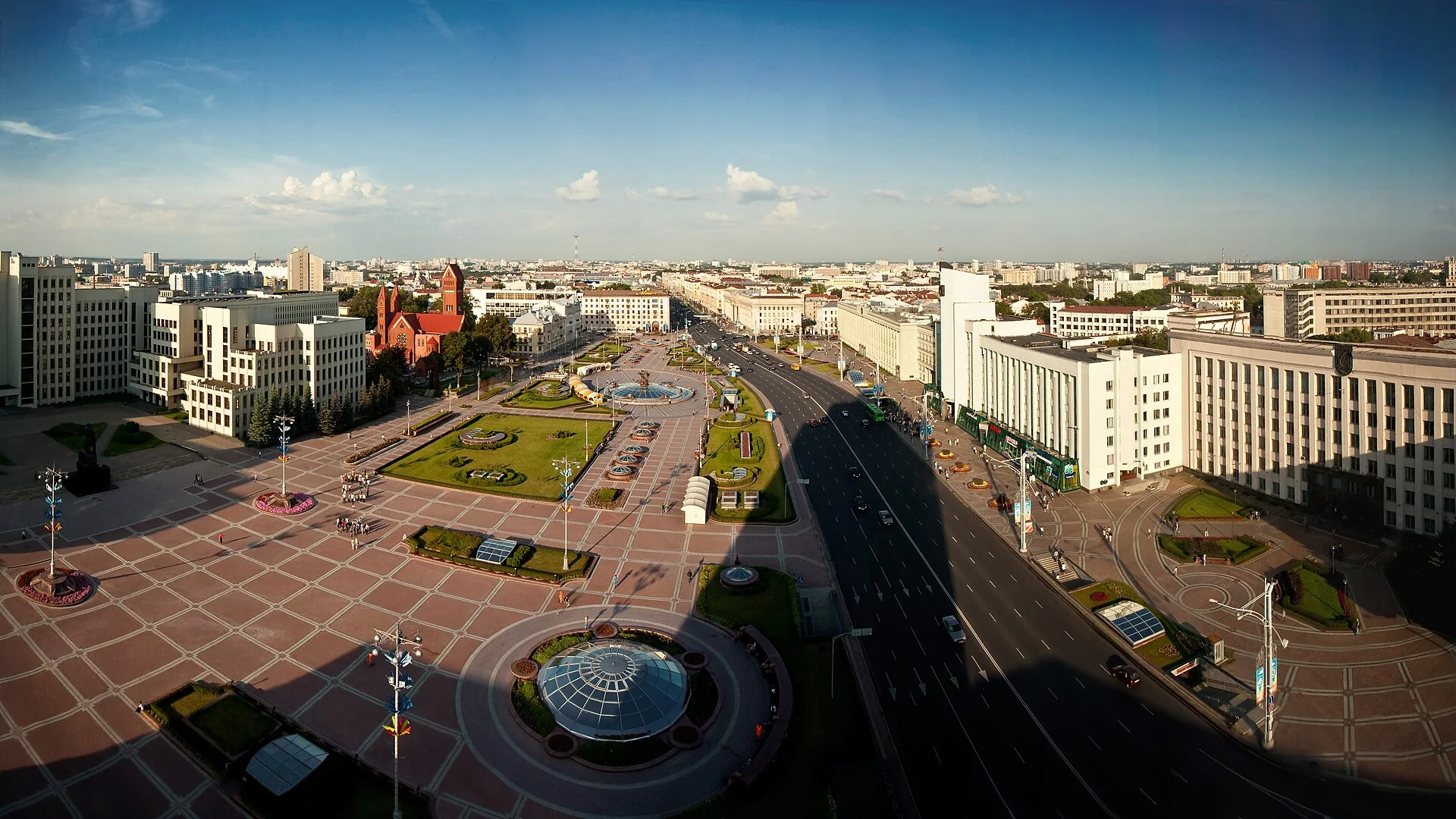
The appeal of Belarus are little known, but the off the beaten track character of this unfamiliar country is exactly what makes it special to the people that visit. Much of the historic heritage was lost to World War II violence or to post-war communist planning, but there's more to see than one might expect at first glance. Take Minsk , the country's surprisingly modern and distinctively Eastern European capital, bustling with nightclubs and modern restaurants but simultaneously a monument of Communist architecture and city development, as it had to be completely reconstructed after the war. It's home to the fine Belarus State Museum , Independence Square (where democratic protests make world news every so many years) and the former KGB Headquarters but also the humbling Zaslavsky Jewish Monument . Far more western is the border city of Brest , where you'll find the 19th-century Brest Fortress , the site of a long and severe Operation Barbarossa battle and a monument of the Soviet resistance against the Germans.
There are four World Heritage Sites , although one, the Struve Geodetic Arc which provided the basis for the first meridian measurement, offers little more than an inscription to see. Of more interest for visitors are the late medieval Mir Castle Complex and Nesvizh Castle . They are the best of the country's castles, but a few more can be found if you're interested. For a glance of 19th-century life, visit the Dudutki Open Air Museum . Situated near the sleepy, dusty village of Dudutki, this place brings traditional crafts such as carpentry, pottery, handicraft-making and baking to life in old-style wood-and-hay houses.
Culture and food
If you are looking for a national gourmet meal, then you are in the right place. Most of the products and ingredients are organic, and radiation levels are constantly checked in the food to avoid contamination.
Modern Belarusian cookery is based on old national traditions, which have undergone a long historical evolution, with similarities to the Russian cuisine . But the main methods of traditional Belarusian cuisine are carefully maintained by the people.
Dishes made with potatoes, which are called "the second bread", are common in Belarus. The Belarusians bring fame to their beloved potato in their verses, songs and dances. There are special potato cafes in the country where you can try various potato dishes. Many salads include potatoes; they are served together with mushrooms and/or meat; different pirazhki (patties) and baked puddings are made from it. The most popular among the Belarusians is traditional draniki (known as "latkes" to North Americans, but eaten only with sour cream, never apple sauce), thick pancakes prepared from shredded potatoes. The wide spread of potato dishes in Belarusian cuisine can be explained by natural climatic conditions of Belarus which are propitious for growing highly starched and tasty sorts of potatoes.
Planning your route
With an area of 207,595 km 2 (80,153 sq mi), travelling around Belarus should not take a lot of time. A car ride to Brest from Minsk should take you about 4 hours, depending on traffic conditions.
Traffic in Belarus is reasonably quiet, but you should exercise caution when driving your own car. Particular attention should be paid to light traffic and pedestrians, most of whom use the roads without reflectors.
The infrastructure in Belarus was well developed after World War II. The condition of roads varies in different parts of the country. Main roads and roads in the metropolitan area are in fairly good condition. In winter, it is advisable to take the necessary precautions. All year round, you should be prepared for heavy fog in places.
Travel guide text compiled and adapted from Wikivoyage article (contributors). Sections were selected and reordered for this guide. Text is shared under CC BY-SA 4.0. Check current arrangements with your travel consultant.
Plan the full journey
Useful for this trip
This country’s visa guidance has not been fully verified against current official requirements. Confirm the application route for your passport, residence and purpose before making travel commitments.
Review details
Belarus: Official pages were retrieved, but the complete imported guidance has not been corroborated claim by claim for Kenyan ordinary passports. Still to confirm: passport validity, tourist and business eligibility, application route, any exemptions and published processing guidance. Residents using other passports require a separate nationality check.